







Email: sales3@zhefanjewelry.com
What certifications matter for imported brass necklaces?
Practical guide for buyers of custom brass necklaces: plating thickness, anti-tarnish pre-treatments, realistic durability by finish, necessary import certifications and lab tests (EN 1811, ICP-MS), and how to verify supplier claims.
- 1) How thick should gold plating be on custom brass necklaces to avoid early flaking in humid climates?
- 2) What pre-plating treatments should manufacturers use on custom brass necklaces to minimize green skin, allergies, and flaking?
- 3) For private-label imported brass necklaces, which lab tests and certificates should I demand to prove nickel and lead safety?
- 4) How can I verify a supplier's RoHS/REACH/ISO claims for brass jewelry when buying bulk from China?
- 5) What are realistic durability expectations and warranty terms for custom brass necklaces with different finishes (gold plating, vermeil, PVD, antique brass)?
- 6) Can importers rely on XRF spot-checks for lead/nickel compliance, or do I need ICP-MS lab testing for custom brass necklaces?
- Concluding summary: advantages of choosing certified custom brass necklaces
Custom Brass Necklaces: Certifications, Plating Specs & Buyer Checklist
As private-label and OEM buyers of brass jewelry, you need specific, testable criteria to evaluate suppliers and imported stock. Below are six in-depth, buyer-focused questions beginners frequently ask — with actionable answers referencing the real standards and lab methods used in the jewelry supply chain.
1) How thick should gold plating be on custom brass necklaces to avoid early flaking in humid climates?
Short answer: target a plating system and thickness appropriate to the finish and expected wear. Typical electroplating over brass ranges from ~0.05–0.5 microns (50–500 nm); thin fashion plating (0.05–0.2 µm) will show wear within months with daily wear and exposure to perspiration, while higher-quality electroplating (0.3–1.0 µm) or multi-layer systems significantly extend life. For high durability, consider PVD coating or hard gold plating.
Practical guidance:
- Standard fashion electroplate: 0.05–0.2 µm — low cost, suitable for occasional wear or fast fashion. Expect visible wear after weeks–months in humid or high-sweat environments.
- Mid-range electroplate: 0.3–1.0 µm with a nickel or copper flash layer and post-plating passivation — good for private-label necklaces where customers expect months to a year of life under normal use.
- PVD (Physical Vapor Deposition) or hard gold: coatings can be denser and more adherent; PVD coatings are typically in the 0.5–3 µm range (depending on process) and deliver superior scratch and corrosion resistance compared with standard electroplate.
Other factors that matter:
- Layering: a bright copper strike, then nickel flash, then gold increases adhesion. If you want truly hypoallergenic pieces, use a nickel-free underlayer such as a copper-tin or ruthenium barrier.
- Surface preparation: degreasing, micro-etching and pickling remove oils and ensure plating adhesion (see Q2).
- Post-treatment: clear lacquer or anti-tarnish coatings (e.g., benzotriazole-based passivators or PVD top coat) extend life in humid climates.
- Expectations: clearly state expected wear-life in product specs and testing — e.g., “normal daily wear: 6–12 months” vs. “heavy wear or high-sweat conditions: 1–3 months.”
Ask suppliers for process details (micron values or nm), third-party lab abrasion/corrosion tests, and photos of worn samples after accelerated wear tests (salt spray, perspiration simulation).
2) What pre-plating treatments should manufacturers use on custom brass necklaces to minimize green skin, allergies, and flaking?
Green skin and premature tarnish are caused by copper oxidation and interaction with sweat and cosmetics. Effective pre-plating and finishing reduce these reactions significantly.
Recommended factory process steps:
- Precision cleaning and degreasing — ultrasonic cleaning with alkaline cleaners to remove oil and wax from casting/milling residues.
- Micro-etching/pickling — controlled acid pickle to remove the oxide layer and produce a uniform surface for plating.
- Flash/strike layer — a thin copper or specialized nickel-free strike improves adhesion between brass and the plated finish. For allergy-sensitive lines, use nickel-free strikes (e.g., copper-tin, tin, or ruthenium pre-coats).
- Barrier coatings — for higher-end or hypoallergenic products, apply a diffusion barrier (e.g., rhodium or ruthenium) to reduce metal migration from the brass core to the surface.
- Top-coat/passivation — clear lacquers, anti-tarnish coatings, or PVD top layers to seal the finish and reduce contact with skin oils and chlorine.
Quality control checklist to request from suppliers:
- Process flow chart showing cleaning, pickling, strike, plating, and passivation steps.
- Batch photos and in-line thickness measurements (X-section or coulometric where applicable).
- Accelerated corrosion or perspiration testing results (e.g., artificial sweat tests, salt-spray where relevant).
3) For private-label imported brass necklaces, which lab tests and certificates should I demand to prove nickel and lead safety?
Insist on test reports tied to the actual lot or sample (not generic factory claims). The essential tests/certificates are:
- Nickel release test to EN 1811 (or equivalent): measures released nickel (µg/cm2/week). The EU limit for articles in prolonged contact with skin is 0.5 µg/cm2/week; for items intended for pierced ears the limit is 0.2 µg/cm2/week. Ask suppliers for an EN 1811 report from an accredited lab (ILAC-recognized).
- Chemical composition by ICP-OES or ICP-MS: provides total metal content (lead, cadmium, mercury). ICP methods are quantitative and suitable when you need ppm-level confidence. For heavy metals, ICP-MS is the most sensitive.
- XRF screening reports: fast, non-destructive method for screening lots. Useful for incoming inspection but not a substitute for migration or ICP testing because XRF reads surface and bulk differently depending on plating.
- Migration tests where applicable (EN 71-3 for items/children’s jewelry): if the product is marketed for children, request EN 71-3 migration testing for elements like lead and cadmium per toy safety rules.
- Certificate of Conformity (CoC) and Material Safety Data Sheet (MSDS): provide declared material composition, but these are manufacturer declarations and should be backed by lab tests.
Third-party lab names commonly accepted by major retailers: SGS, Intertek, Bureau Veritas and Eurofins. Require reports with lab accreditation (ILAC/MRA) and clear sample identification (photos, SKU, batch/lot #).
4) How can I verify a supplier's RoHS/REACH/ISO claims for brass jewelry when buying bulk from China?
RoHS is primarily for electronic products, but suppliers sometimes claim RoHS/REACH compliance for metals. REACH Annex XVII and SVHC lists affect jewelry (cadmium and lead restrictions). To verify claims:
- Request specific documentation and test evidence tied to your SKU: REACH/SVHC screening report (analytical method and LOQs), ICP-MS/ICP-OES results for restricted substances, and a CoC that references tested samples.
- Check lab accreditation: reports should be from ILAC-recognized labs. Look for the lab’s accreditation number on the report and verify via the lab’s accreditation body.
- Order pre-shipment composite samples and run independent tests in your chosen lab. Relying solely on factory documents is risky; random third-party testing reduces compliance and brand risk.
- Factory audit and control points: review plating lines, chemical storage, and process controls. Ask for process control charts, water treatment methods, and buy-off criteria for plating thickness and adhesion.
- Chain of custody: get batch numbers, plating bath logs, and photos of finished goods tied to the tested samples — especially if you intend to use retailer or customs channels that require documented compliance.
Note: Some jurisdictions require testing and documentation at import. If selling in the EU, ensure REACH/CLP implications are clear; in the US, follow CPSC guidance for children’s items and check state-level rules (e.g., California).
5) What are realistic durability expectations and warranty terms for custom brass necklaces with different finishes (gold plating, vermeil, PVD, antique brass)?
Durability depends on base metal, plating thickness, finish type and user behavior. Typical lifetime expectations under normal daily use:
- Thin electroplate (0.05–0.2 µm): 1–6 months. Good for seasonal or fashion pieces; offer limited warranties (30–90 days).
- Mid-range electroplate (0.3–1.0 µm + passivation): 6–24 months. Appropriate for core private-label lines; consider 6–12 month warranties with wear policies.
- Vermeil (applies to silver base): 2.5 µm min gold over silver — not common over brass; if you need vermeil-like quality, use thicker plating + high-quality underlayers. Expect 1–3 years with careful wear.
- PVD coatings and hard coatings: 2–5+ years depending on thickness and mechanical wear. Offer 1–2 year warranties for normal use; beneficial for High Quality lines.
- Antique brass (no plating or sealed patina): will intentionally age and develop patina — not a defect. Provide care instructions and consider no-fade warranty unrealistic for patina finishes.
Warranty drafting tips:
- Define “normal use” vs. misuse (e.g., exposure to chlorine, cosmetics, or mechanical abrasion).
- Base warranty length on tested wear-life (accelerated wear tests or customer field trials).
- Require photographs, order numbers and SKU batch codes for claims; this discourages fraud and helps trace manufacturing issues.
6) Can importers rely on XRF spot-checks for lead/nickel compliance, or do I need ICP-MS lab testing for custom brass necklaces?
XRF (handheld or lab-grade) is a fast and effective screening tool for heavy metals such as lead and cadmium. However, it has limitations:
- Depth sensitivity: XRF measures near-surface composition and may read the plating rather than the brass core. If a piece is plated, XRF may under- or overestimate bulk metal content depending on thickness and matrix effects.
- Detection limits: handheld XRF limits vary by element and instrument; typical practical limits for heavy metals are tens to low hundreds of ppm — fine for quick screens but not for low-ppm certification requirements.
- Non-destructive but semi-quantitative: suitable for in-line QC or pre-shipment acceptance but not always accepted by regulators or retailers as definitive proof of compliance.
When to use ICP-MS/ICP-OES instead:
- Final compliance: regulatory or retailer-required documentation usually demands ICP-based test reports or migration tests (EN 71-3, or ICP after digestion) with clear LOQs and accredited lab signatures.
- Plating vs core ambiguity: if plating masks core metals (brass core containing lead or cadmium), destructive analysis (acid digestion + ICP) provides accurate total content.
- Low-ppm requirements: when limits are in single-digit or low double-digit ppm, ICP-MS sensitivity is needed.
Recommended protocol for importers: use XRF for 100% incoming lot screening, and send statistically valid random samples (or failing XRF results) to an ILAC-accredited lab for ICP-MS or migration testing. Keep original lab reports and correlate batch numbers with production dates for traceability.
Concluding summary: advantages of choosing certified custom brass necklaces
Choosing certified custom brass necklaces—where plating processes, passivation, and third-party testing (EN 1811, ICP-MS/ICP-OES, EN 71-3 where relevant) are documented—reduces product returns, protects Zhefan Jewelry, and speeds retailer and customs acceptance. Properly specified plating thickness, pre-treatment and barrier layers produce cost-effective pieces that meet customer expectations for durability and hypoallergenic performance. Using XRF for routine QC and accredited lab testing for certification creates a practical, defensible compliance program.
Contact us for a quote or to request the exact test reports and finishing specs for our private-label brass jewelry: visit www.zhefanjewelry.com or email sales3@zhefanjewelry.com.
Recommended for you
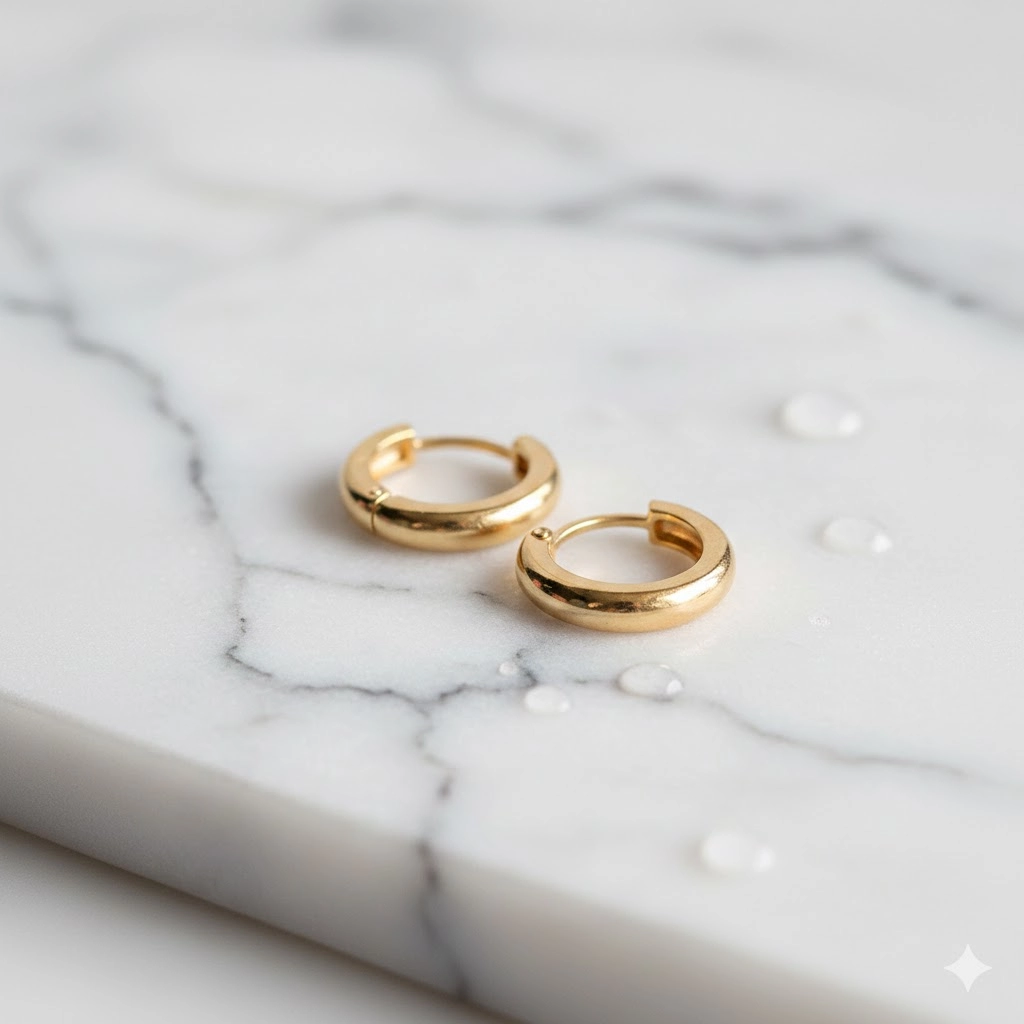
Boost Your Margins with Top-Selling Custom Wholesale Brass Huggie Earrings
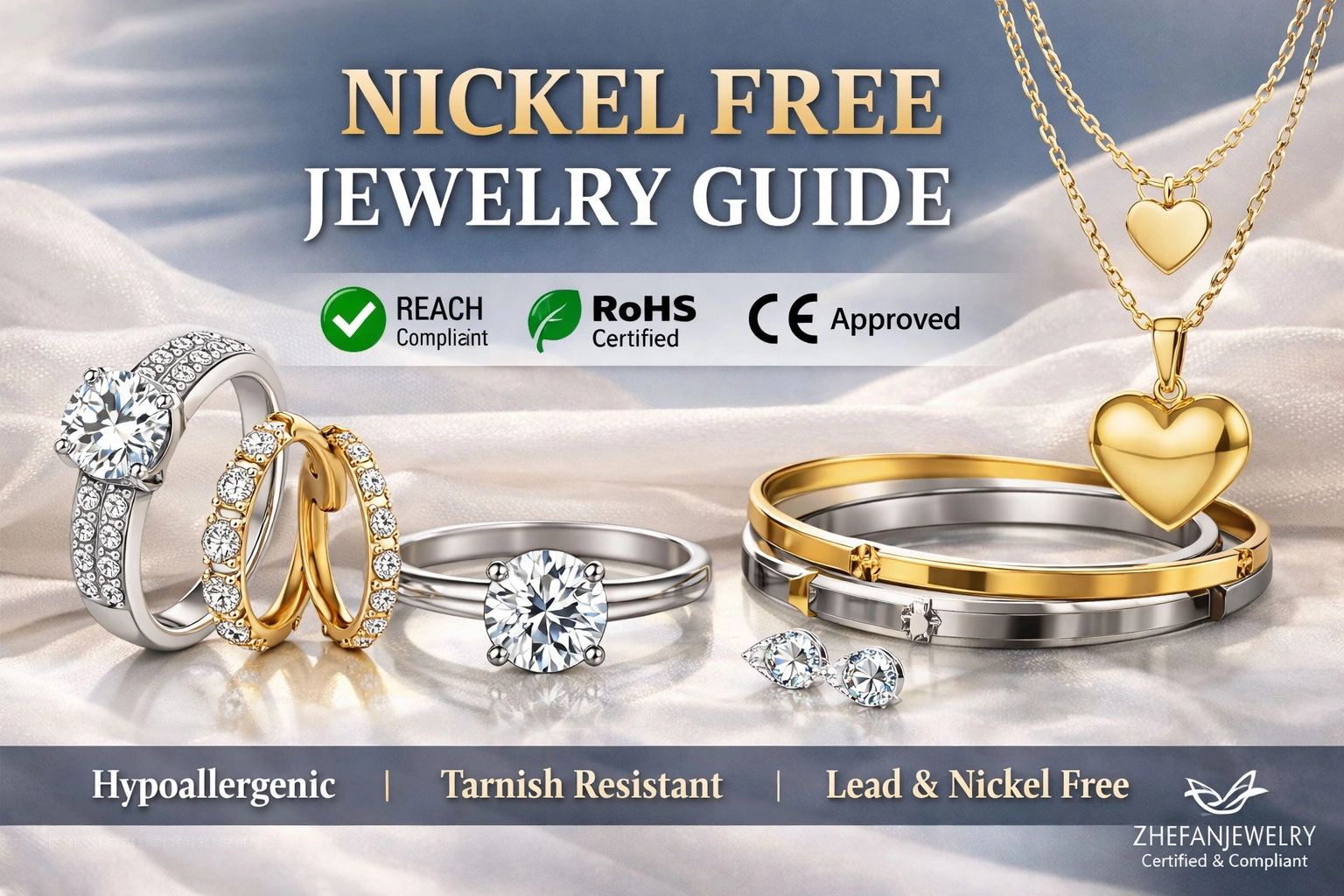
What Is Nickel Free Jewelry? Meaning, Benefits & Does It Tarnish? (Complete Guide 2026)
Choosing the Right Metal for Jewelry Making - Practical Guide
Launch Your Brand: The Ultimate Guide to Manufacturing Custom Sterling Silver Jewelry

The Ultimate Buyer's Guide to Custom Wholesale Brass Huggie Earrings in China
The Secret Behind Premium Quality: 7 International Standards for 925 Sterling Silver Rings
Prdoucts Categories
FAQ
Products
What's the packaging of your jewelry?
Normally we use OPP bag, bubble bag and paper box to pack the goods,custom packaging is acceptable as well.
Can you engrave my logo on the jewelry ?Do you supply OEM/ODM service?
Yes. Custom logo and OEM/ODM are both accepted.Our factory specializes in jewelry manufacturing for 25 years.We can produce jewelry by your sample, design, pictures, even by an idea.Please feel free to contact us for more details. Custom order process: Inquiry-Confirm products details-Pay mold fee -Confirm CAD draft-Quote-Initial payment-Produce mold & sample-Confirm Sample-Mass production-Balance payment-Shipment-Track shipment-delivery.
What services can we provide?
Accepted Delivery Terms: FOB, CIF, EXW, Express Delivery;
Accepted Payment Currency: USD, EUR, JPY, CAD, AUD, HKD, GBP, CNY, CHF;
Accepted Payment Type: T/T, L/C, MoneyGram, Credit Card, PayPal, Western Union, Cash, Escrow;
Language Spoken: English, Chinese, Spanish, Japanese, Portuguese, German, Arabic, French, Russian, Korean, Hindi, Italian.
What’s the lead time?
We could arrange shipment for you within 48 hours if you order models in stock. For bulk order, it takes 10-25 days for production depending on order quantity and styles.
FAQs
Can you engrave my logo on the jewelry ?Do you supply OEM/ODM service?
Yes. Custom logo and OEM/ODM are both accepted. Our factory specializes in jewelry manufacturing for 27 years.We can produce jewelry by your sample, design, pictures, even by an idea.Please feel free to contact us for more details. Custom order process:Inquiry-Confirm products details-Pay mold fee -Confirm CAD draft-Quote-Initial payment-Produce mold&sample-Confirm Sample-Mass production-Balance payment-Shipment-Track shipment-delivery.
Can I have your product catalog?
Yes, please leave us a message what style jewelry catalog you need.
Discuss Your Ideas with a Professional Custom Jewelry Manufacturer
We provide personalized jewelry customization services for clients worldwide.
Rest assured that your privacy is important to us, and all information provided will be handled with the utmost confidentiality.
By clicking 'Send Inquiry Now' I agree to ZHEFAN JEWELRY processing my personal data.
To see how to withdraw your consent, how to control your personal data and how we process it, please see our Privacy Policy and Terms of use.
From design to production, ZHEFAN JEWELRY offers a one-stop solution to help you enhance your brand value and market competitiveness.
Get A Quote
Contact
Tel: (+86) 188 1927 7817
© 2026 Zhefan Jewelry. All Rights Reserved.
Facebook
Instagram
YouTube
Whatsapp: +8618819277817