




Email: sales3@zhefanjewelry.com
What testing reports (e.g., XRF) should accompany 925 bracelets? | Insights by Zhefan Jewelry
Practical guidance on which testing reports should accompany 925 (sterling) bracelets: XRF element analysis, accredited lab reports (ICP‑MS/AAS), nickel migration (EN 1811), cadmium/lead tests, plating thickness checks, hallmark verification and sampling plans to reduce buyer risk.
- Can XRF distinguish a thin silver plating over base metal from solid 925 sterling silver on bracelets?
- If an XRF report shows 91.2% Ag, is that non-compliant for '925' bracelets and what measurement uncertainty should I expect?
- What specific third-party lab reports should be provided to prove a 925 bracelet is nickel-safe for EU sensitive-skin consumers?
- What should I look for in an XRF report header and metadata to ensure it's valid and customs/court admissible?
- How many pieces per batch should be tested and what sampling plan is acceptable for import/customs compliance for 925 bracelets?
- When a supplier provides a '925 certificate' without lab data, how can I independently verify authenticity before large orders?
- Concluding summary: advantages of comprehensive testing reports for 925 bracelets
Can XRF distinguish a thin silver plating over base metal from solid 925 sterling silver on bracelets?
Short answer: Not reliably on its own. Portable and bench XRF effectively measure surface elemental composition and will report a high Ag percentage when the surface is silver — whether that silver is bulk sterling (92.5% Ag) or a thin silver plating over a base metal. That creates a major pain point for buyers: a supplier can present an XRF report that looks like 92.5% Ag while the part is actually plated.
How to handle it in practice:- Ask for XRF reports that explicitly state mode (bulk vs. coating), measurement spot size, and whether a stratigraphy/coating routine was used. Some lab XRF units have a coating mode that estimates plating thickness (useful for plating >~0.1 µm), but this is instrument- and operator-dependent.- Require complementary tests that differentiate surface vs. bulk: a metallographic cross-section (microsection) with optical microscopy or SEM/EDX will show plating layers and thickness; destructive ICP‑MS/AAS on a drilled sample measures true bulk Ag concentration; density (specific gravity) tests are a quick non‑destructive check for large differences between plated base metal and solid silver.- For high-value orders, include microsection photos, plating thickness reports, and an ISO/IEC 17025-accredited lab statement in the documentation package.Practical threshold: If the XRF coating routine reports a silver layer but thickness is reported as <0.1 µm or is not reported at all, require a confirmatory destructive test. Insist on chain-of-custody and calibrated standards in the XRF metadata to reduce false confidence.
If an XRF report shows 91.2% Ag, is that non-compliant for '925' bracelets and what measurement uncertainty should I expect?
925 (sterling) legally denotes at least 92.5% silver by mass. An XRF readout of 91.2% is a red flag but not an absolute verdict because XRF accuracy depends on several factors.
Key considerations:- Measurement uncertainty: Typical XRF accuracy for major elements can be on the order of ±0.1–0.5% absolute for well-calibrated bench analyzers on homogeneous samples. The lab should report the method uncertainty—an XRF report without an uncertainty range is incomplete for conformity decisions.- Surface contaminations, plating, patina, or surface treatments can depress the measured Ag%. Cleaning and re-measuring in multiple spots helps rule out surface effects.- Confirmatory testing: If the reported Ag% is below 92.5% and within the instrument’s uncertainty margin, request a destructive confirmatory assay (ICP‑OES/ICP‑MS or gravimetric/silver cupellation when applicable) from an ISO/IEC 17025 lab. Those methods provide traceable bulk composition and lower measurement uncertainty.Actionable rule: Treat XRF as a fast screening tool. Any reading <92.5% (or within ~0.5% of 92.5% without a stated uncertainty) should trigger a destructive confirmatory test before accepting the batch or using the '925' claim in labeling.
What specific third-party lab reports should be provided to prove a 925 bracelet is nickel-safe for EU sensitive-skin consumers?
Sensitive-skin buyers often worry about nickel release, not just elemental nickel presence. For EU and many global markets, you should expect:
- A nickel release (migration) test report compliant with EN 1811 (or equivalent), stating the release rate in µg/cm²/week. The EU Nickel Directive limit for items in direct and prolonged contact with skin is 0.5 µg/cm²/week for post‑2005 items (verify current national transpositions where you sell).
- Where applicable, simulated wear tests such as EN 12472 can be used in combination with EN 1811 to represent how wear affects nickel release.
- A cadmium migration test (EN 71‑3 or national limits) and lead content testing (e.g., for children’s jewelry separate stricter rules apply—check CPSIA for U.S.; for general adult jewelry, maintain low ppm trace levels and document testing).
- A statement of compliance with REACH and a RoHS check if electronic components are present. Ensure all lab reports come from ISO/IEC 17025-accredited labs (Intertek, SGS, Bureau Veritas, or other accredited national labs) with chain-of-custody and clear sample identifiers.
Demand explicit pass/fail against the standard and the tested surface area, sample IDs, testing date and method, and laboratory accreditation number. Without EN 1811-style migration tests, a simple elemental Ag or Ni XRF is insufficient to claim 'nickel‑safe.'
What should I look for in an XRF report header and metadata to ensure it's valid and customs/court admissible?
Many XRF prints are superficial. For procurement and customs, insist on these metadata items — they determine the report’s evidentiary value:
- Laboratory name, address, and accreditation (ISO/IEC 17025) and scope number.
- Sample identifier(s), detailed photos (including stamps/hallmarks), and description (weight, dimensions, lot number).
- Date of sampling and date of analysis; name of operator and instrument serial number/model.
- Measurement mode (bulk vs. coating), spot size, number of spots averaged, and any sample preparation (cleaning, polish, cross-section).
- Calibration standards used, reference materials, and a statement of measurement uncertainty (expanded uncertainty, k factor) and limits of detection (LOD).
- Raw or processed spectra appended or available on request; method SOP or reference to the analytical standard.
- Chain-of-custody or sampling witness statement: who collected/forwarded the sample and packaging condition.
A report missing these elements may be acceptable for informal supplier checks but is weak for customs disputes or litigation. Always prefer ISO/IEC 17025-accredited lab reports with full metadata.
How many pieces per batch should be tested and what sampling plan is acceptable for import/customs compliance for 925 bracelets?
There is no universal single-sample rule; sampling should be risk-based and defensible. Practical guidance used by importers and QC teams:
- Small production runs (≤50 pieces): test every piece for critical attributes (Ag content, nickel release, plating thickness).
- Medium/large runs (>50 pieces): adopt a statistically defendable sampling plan such as ISO 2859‑1 (AQL) for dimensional/visual defects. For chemical composition and safety-critical tests (nickel, lead, cadmium), test a higher proportion—commonly 2–5% of the lot as a minimum, with a floor of 5–10 pieces depending on lot variability and product value.
- For continuous suppliers with historical quality data, implement periodic verification: e.g., full chemical testing quarterly and spot checks by AQL between full tests.
- If the product is plated, test the first 10 pieces from each new die/tooling batch and at least one random piece per 1,000 produced to monitor plating consistency and adhesion.
For customs or regulatory audits, pair sampling with clear documentation: batch numbers, production dates, supplier certificates, and chain-of-custody for tested samples. If in doubt, rely on an accredited lab’s sampling recommendation and document why your sample plan is appropriate for the risk profile.
When a supplier provides a '925 certificate' without lab data, how can I independently verify authenticity before large orders?
Many suppliers provide certificate templates that lack verifiable data. To protect yourself, follow a layered verification approach:
- Request the original lab report (not a supplier-stamped certificate) with full metadata from an ISO/IEC 17025 lab. Verify accreditation on the lab’s website and check report IDs against the issuing lab.
- Ask for high-resolution photos of hallmarks/stamps, dimensions and the item weight so you can run a density check (specific gravity) to flag obvious base-metal items posing as sterling.
- Order a small paid sample and send it to an independent third-party lab (SGS, Intertek, Bureau Veritas, or a national reference lab) for XRF and at least one destructive confirmatory test (ICP‑MS/AAS) if results matter commercially.
- Perform quick bench checks in-house (magnet test, acid test kits, electronic silver testers). These are not definitive but can catch obvious fraud before spending on lab assays.
- Check the supplier’s manufacturing records: sourcing of raw silver (melting records), hallmark registration (if applicable) and any internal QC logs showing lot testing history.
Do not accept a bare '925 certificate' as proof. Independent lab verification plus chain-of-custody documentation is the industry standard for importers and professional buyers.
Concluding summary: advantages of comprehensive testing reports for 925 bracelets
Comprehensive documentation — combining XRF screening, accredited ICP/AAS confirmatory assays, nickel migration (EN 1811), plating thickness measurement or microsection images, and full lab metadata (ISO/IEC 17025) — reduces commercial and regulatory risk. Benefits include defensible customs clearance, fewer chargebacks from retailers, reduced returns and allergic-reaction claims, and improved supplier accountability. For buyers, the incremental testing cost is small compared with the cost of a large rejected shipment, brand damage, or product recalls.
For a free testing quote or to arrange sample verification, contact us at www.zhefanjewelry.com or email sales3@zhefanjewelry.com.
Recommended for you
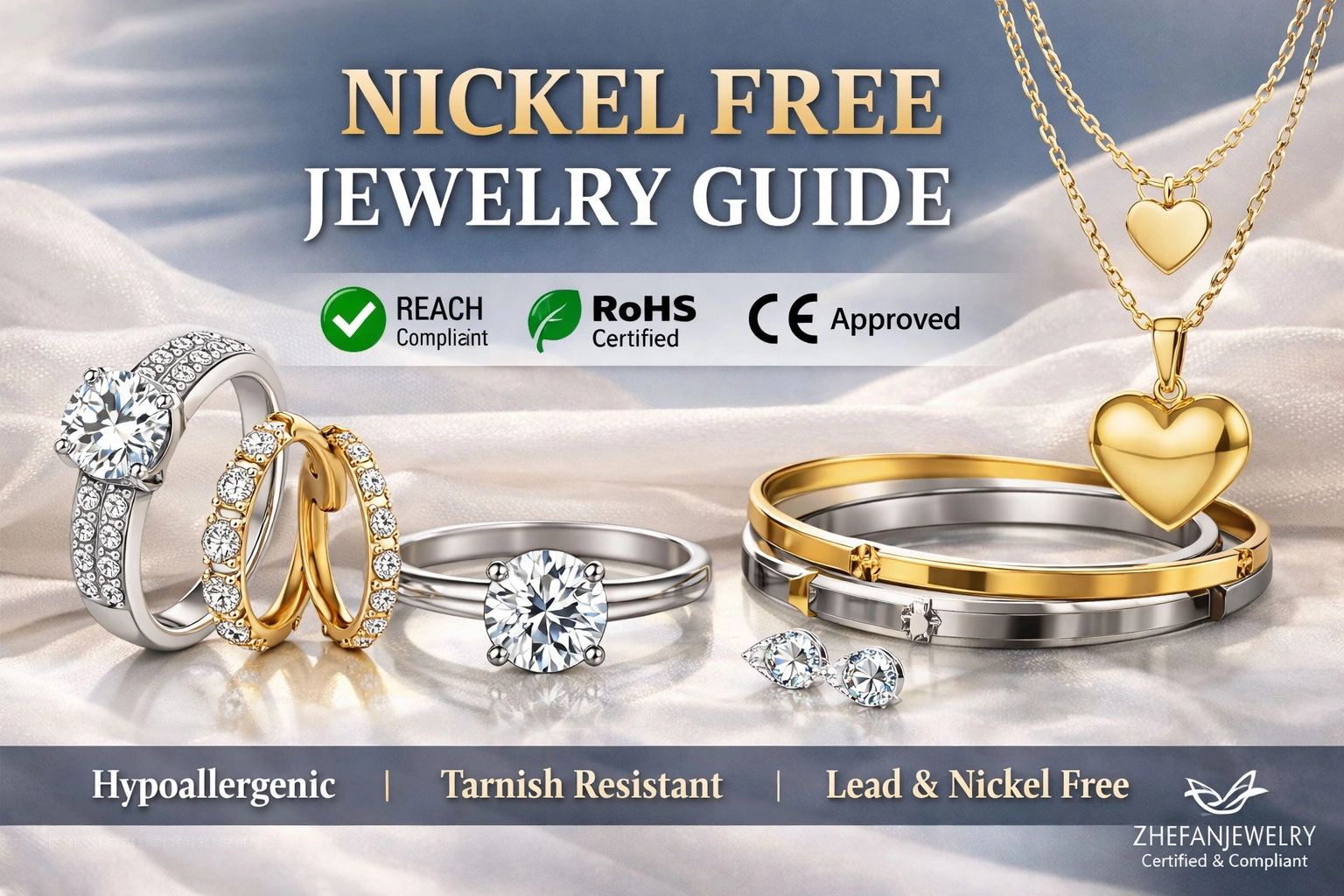
What Is Nickel Free Jewelry? Meaning, Benefits & Does It Tarnish? (Complete Guide 2026)

Zhefan Jewelry Invites You to Attend the Hong Kong Jewellery Exhibition 2026
Why Custom 925 Sterling Silver Bracelets Are the Ultimate 2026 Jewelry Trend
5 Costly Mistakes to Avoid When Sourcing Custom Sterling Silver Jewelry
The Secret Life of Your Silver: How 925 Sterling Jewelry Comes to Exist
Is a Brass Necklace Good? The Honest Truth About Wear, Tarnish, and Quality
Prdoucts Categories
FAQ
Products
What’s the shipment method? How long does it take for delivery?
Our product distributed to all over the world. Shipped by DHL / Fedex / TNT / UPS takes 3-7 days, Epacket takes 7-15 days, China Post takes 15-30 days.
What's the packaging of your jewelry?
Normally we use OPP bag, bubble bag and paper box to pack the goods,custom packaging is acceptable as well.
How can we guarantee quality?
Always a pre-production sample before mass production;
Always final Inspection before shipment;
FAQs
Can you engrave my logo on the jewelry ?Do you supply OEM/ODM service?
Yes. Custom logo and OEM/ODM are both accepted. Our factory specializes in jewelry manufacturing for 27 years.We can produce jewelry by your sample, design, pictures, even by an idea.Please feel free to contact us for more details. Custom order process:Inquiry-Confirm products details-Pay mold fee -Confirm CAD draft-Quote-Initial payment-Produce mold&sample-Confirm Sample-Mass production-Balance payment-Shipment-Track shipment-delivery.
How long does it take for the product to fade?
The normal electroplating quality color retention time of our products is 5 times longer than the market, and the thicker electroplating can retain color for three years.
Do you attend any jewelry fairs?
Yes, we participate in Hong Kong Jewelry Fair and Canton Fair twice a year, please contact the seller for the latest invitation.
Discuss Your Ideas with a Professional Custom Jewelry Manufacturer
We provide personalized jewelry customization services for clients worldwide.
Rest assured that your privacy is important to us, and all information provided will be handled with the utmost confidentiality.
By clicking 'Send Inquiry Now' I agree to ZHEFAN JEWELRY processing my personal data.
To see how to withdraw your consent, how to control your personal data and how we process it, please see our Privacy Policy and Terms of use.
From design to production, ZHEFAN JEWELRY offers a one-stop solution to help you enhance your brand value and market competitiveness.
Get A Quote
Contact
Tel: (+86) 188 1927 7817
© 2026 Zhefan Jewelry. All Rights Reserved.
Facebook
Instagram
YouTube
Whatsapp: +8618819277817