





Email: sales3@zhefanjewelry.com
Does Gold-Plated Brass Tarnish? What Jewelry Brands Should Know Before Sourcing
Yes, gold-plated brass can tarnish or fade over time, but plating thickness alone does not determine performance. This B2B sourcing guide explains how brass preparation, coating structure, gold thickness, product geometry, XRF verification, and quality control affect the durability of gold-plated brass jewelry—and what brands should specify before bulk production.
- Does Gold-Plated Brass Tarnish?
- Tarnishing, Fading, and Plating Failure Are Not the Same Thing
- Why “18K Gold Plated” Is Not a Sufficient Purchasing Specification
- Recommended B2B Plating Specification Framework
- What Actually Determines Gold-Plated Brass Durability?
- 1. Surface Preparation Comes Before Plating Thickness
- 2. Gold Thickness Matters, but It Must Be Evaluated in Context
- Practical Plating-Thickness Framework for Brand Sourcing
- Product Geometry Changes the Plating Requirement
- Barrier Layers and Underlayers Matter
- 18K Gold Does Not Mean Thick Gold Plating
- Does Thicker Gold Plating Mean the Jewelry Will Not Tarnish?
- Gold-Plated Brass vs Gold Vermeil: Why the Terminology Matters
- How Should Brands Verify Gold-Plated Brass Quality?
- Plating Thickness Should Be Measured, Not Assumed
- What Salt-Spray Testing Can—and Cannot—Tell a Jewelry Buyer
- What Should Jewelry Brands Confirm Before Bulk Production?
- Why the Cheapest Gold-Plated Brass Quote May Not Be the Lowest-Cost Option
- Gold-Plated Brass or Gold-Plated Sterling Silver?
- Sourcing Gold-Plated Brass Jewelry From Zhefan Jewelry
- Planning a Gold-Plated Brass Collection?
- Final Answer: Does Gold-Plated Brass Tarnish?
- FAQ
Does Gold-Plated Brass Tarnish?
Yes. Gold-plated brass can eventually tarnish, fade, or change appearance as the plated surface wears or the underlying brass becomes exposed.
For jewelry brands, wholesalers, and private-label buyers, however, the more useful question is
Why do some gold-plated brass products maintain a consistent finish better than others that look almost identical when new?
The answer lies in the complete coating system.
The performance of gold-plated brass depends on the condition of the brass before plating, surface preparation, intermediate layers, gold thickness and uniformity, jewelry geometry, protective finishing, and actual wear conditions.
For B2B buyers, this leads to an important sourcing principle:
“18K gold-plated brass” is a finish description—not a complete quality specification.
Two factories can use the same description while delivering products with very different coating structures, wear performance, and production consistency.
For a deeper explanation of the base metal itself, see our guide on why brass jewelry tarnishes and how brands can reduce it.
Tarnishing, Fading, and Plating Failure Are Not the Same Thing
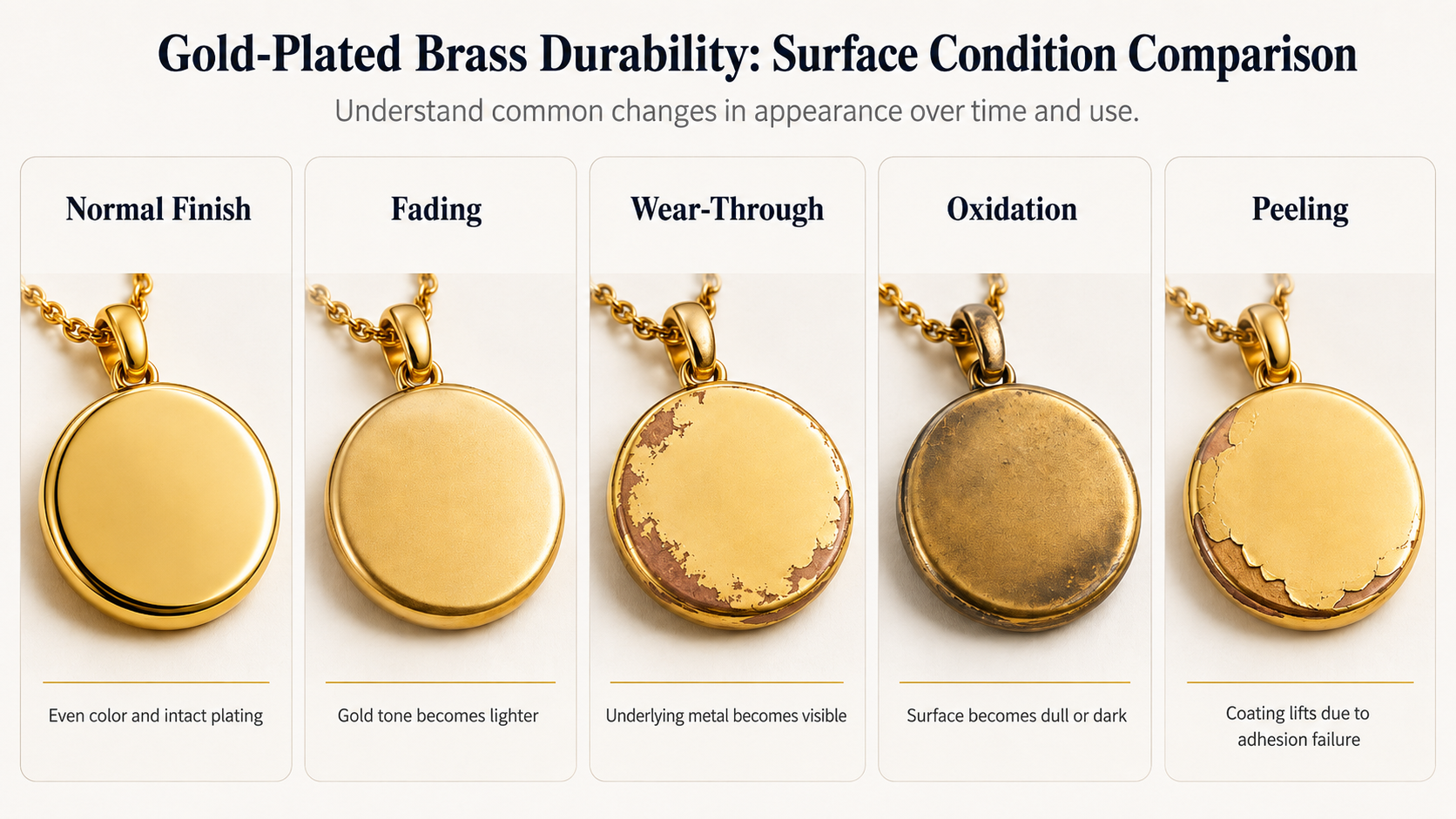
Buyers often use the word "tarnish" for several different appearance problems. From a quality-control perspective, distinguishing them is important because the root causes are not always the same.
|
Appearance Change |
Likely Technical Explanation |
What Buyers Should Investigate |
|
The gold color gradually becomes lighter. |
Progressive wear of the decorative gold layer |
Gold thickness, friction, and product usage |
|
Base-metal or underlayer color becomes visible. |
Plating has worn through in high-contact areas. |
Thickness distribution and wear zones |
|
The surface becomes dull or darker. |
Oxidation, contamination, or coating deterioration |
Surface preparation and coating integrity |
|
Uneven spots or color variation develop. |
Pretreatment or plating consistency issue |
Process control and batch uniformity |
|
Blistering or peeling appears. |
Adhesion failure within the coating system |
Cleaning, activation, and underlayer adhesion |
|
Greenish discoloration develops. |
Copper-rich substrate may be exposed to moisture or skin. |
Base-metal exposure and barrier-layer performance |
Increasing gold thickness can improve resistance to mechanical wear, but it cannot correct weak adhesion, contamination, poor polishing, or an unstable underlying coating system.
This is why coating problems should be investigated as a system-level quality issue, rather than being attributed to thickness alone.
Why “18K Gold Plated” Is Not a Sufficient Purchasing Specification
A common purchase-order description may look like this:
Material: Brass
Finish: 18K Gold Plated
That describes the base material and surface appearance, but it does not define expected performance.
One supplier may use a thin decorative deposit primarily to achieve the required gold tone. Another may use more controlled polishing and pretreatment, a defined intermediate layer, specified gold thickness, protective finishing, and measurable batch inspection.
Both products can still be described as 18K gold-plated brass.
For OEM, ODM, and private-label sourcing, brands should therefore define the finish through measurable parameters.
Recommended B2B Plating Specification Framework
|
Specification |
What Should Be Defined |
|
Base material |
Brass grade or agreed substrate specification |
|
Surface condition |
Polishing and pretreatment standard |
|
Intermediate layer |
Barrier or underlayer system where required |
|
Gold finish |
Karat designation and approved color reference |
|
Gold thickness |
Target micron specification and tolerance |
|
Protective finish |
E-coating or other topcoat, where applicable |
|
Thickness verification |
XRF or another agreed measurement method |
|
Appearance standard |
Color consistency, scratches, pinholes, peeling, and blistering |
|
Compliance |
Requirements for the destination market |
|
Bulk acceptance |
Sampling method and agreed acceptance criteria |
This framework allows buyers to compare suppliers on equivalent technical specifications, rather than comparing quotations for products that only appear equivalent.
What Actually Determines Gold-Plated Brass Durability?
1. Surface Preparation Comes Before Plating Thickness
The quality of a plated finish starts with the brass substrate.
Casting porosity, polishing marks, oxidation, oil, solder residue, and polishing compounds can affect the appearance or adhesion of subsequent coating layers. Because electroplating follows the condition of the underlying surface, a thicker gold layer cannot compensate for a poorly prepared substrate.
Polishing, cleaning, activation, and plating should therefore be treated as one connected surface-finishing process.
A properly prepared surface provides a more stable foundation for coating adhesion and consistent bulk appearance. This becomes especially important on jewelry with stone settings, recessed details, flexible links, or complex shapes.
When evaluating a supplier, brands should ask not only
“How thick is the gold?” But also, "How is the brass prepared before plating, and how is that process controlled from sample to bulk production?”
2. Gold Thickness Matters, but It Must Be Evaluated in Context
Gold-plating thickness is an important purchasing variable because it affects how much decorative coating is available before wear reaches the underlying layers.
However, it should not be used as a stand-alone prediction of product lifespan.
A ring, bracelet, pendant, and earring may perform differently even when the nominal gold thickness is identical. Rings and bracelets typically receive more direct friction, while many pendant and earring surfaces experience less abrasion. Product geometry, surface preparation, perspiration, cosmetics, water exposure, and the overall coating structure also influence performance.
The correct B2B approach is to treat micron thickness as one measurable parameter within the complete product specification, rather than converting it into a guaranteed number of months or years.
Practical Plating-Thickness Framework for Brand Sourcing
|
Gold Thickness |
Typical Purchasing Objective |
B2B Interpretation |
|
0.05–0.25 µm |
Cost-sensitive or appearance-led fashion programs |
Suitable when decorative appearance and cost control are primary objectives |
|
0.5–1 µm |
Upgraded plated fashion jewelry |
More substantial specification than very thin decorative plating |
|
2.5 µm |
Thick gold-plated brass programs |
Suitable when a brand intentionally requires a substantially thicker plated finish |
|
3 µm and above |
Premium thick-plated programs |
Higher precious-metal costs make verification and production consistency increasingly important. |
These categories are best used as sourcing references rather than lifetime guarantees.
The appropriate thickness should be selected according to product type, expected wear, retail positioning, target cost, and the brand's quality requirements.
Brands comparing different micron programs can also review our thick gold-plated jewelry manufacturing guide.
Product Geometry Changes the Plating Requirement
Plating performance cannot be separated from jewelry design.
Areas exposed to repeated skin contact, mechanical movement, or surface-to-surface friction generally face greater coating stress than decorative surfaces with little abrasion.
This means brands should evaluate not only nominal thickness but also where the coating is most likely to wear first.
|
Jewelry Category |
Main Wear Characteristics |
Sourcing Focus |
|
Rings |
Continuous skin contact, handwashing, and high friction |
Shank, edges, and contact surfaces |
|
Bracelets |
Repeated contact with desks, clothing, and other jewelry |
Underside, clasp, and moving components |
|
Chains |
Link-to-link movement and friction |
Link contact areas and closure components |
|
Pendants |
Lower overall abrasion but repeated skin contact on the back |
Pendant back and connection points |
|
Earrings |
Generally lower external friction |
Posts, backs, edges, and skin-contact surfaces |
|
Tennis Jewelry |
Numerous joints, settings, and flexible sections |
Consistent coverage around links, settings, and clasp areas |
A professional specification should therefore reflect the wear profile of the actual product, rather than applying one generic durability expectation across an entire collection.
For a practical example, see Zhefan's custom gold-plated brass earrings.
Barrier Layers and Underlayers Matter
Gold-plated brass does not necessarily consist of only brass and gold.
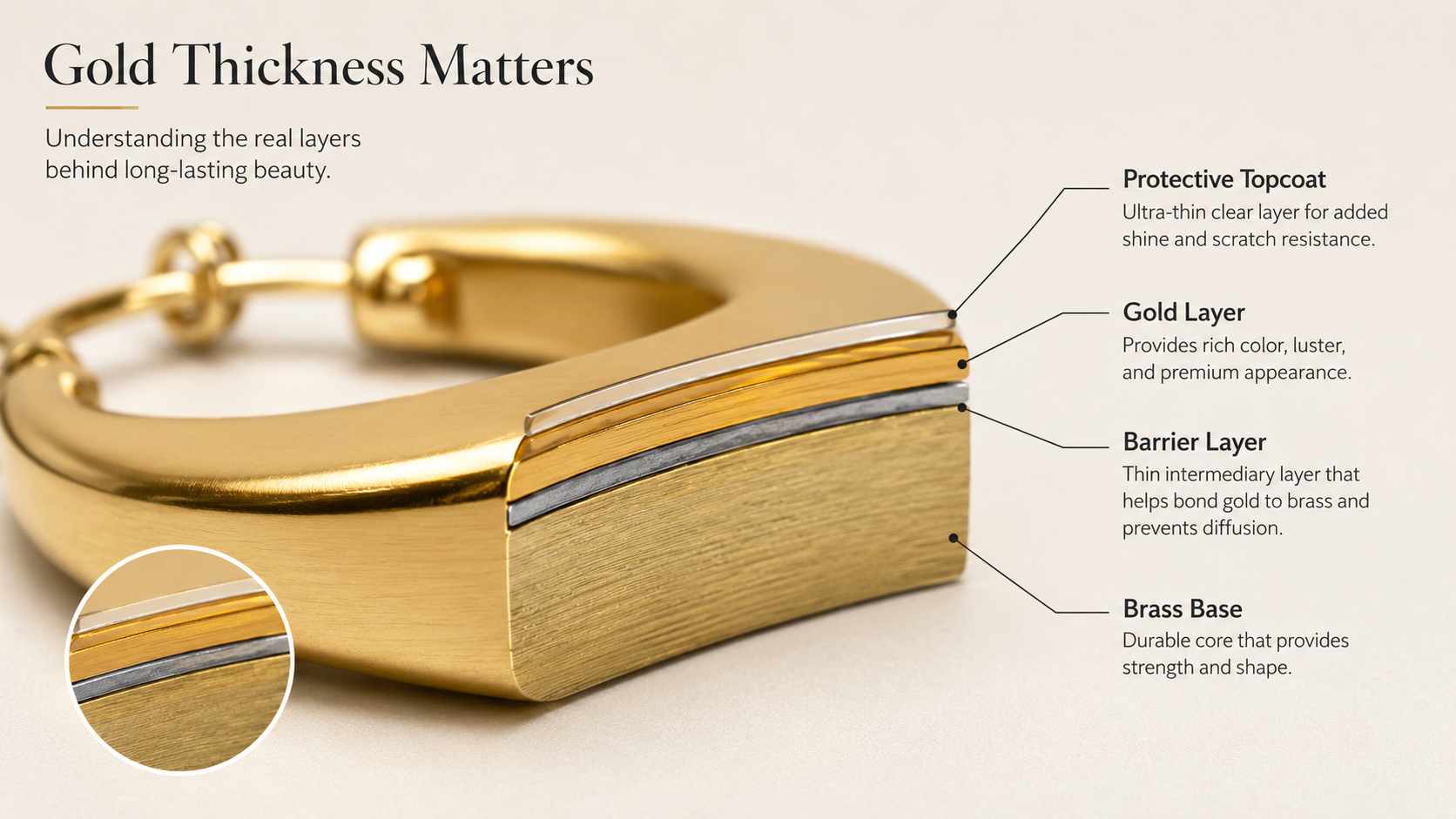
Depending on plating chemistry, product design, performance requirements, and destination market, one or more intermediate layers may be used between the brass substrate and the decorative gold surface.
These layers may help stabilize the substrate, reduce interaction between copper-rich brass and the decorative finish, support adhesion, or improve coating consistency.
For brands requiring a nickel-free specification, the chemistry of the full layer structure should be confirmed rather than evaluating only the outer gold surface.
The more useful sourcing question is therefore
“What is the complete layer structure between the brass substrate and the finished surface?”
This becomes especially important when a brand makes restricted-substance, nickel-free, or skin-contact claims.
18K Gold Does Not Mean Thick Gold Plating
Gold karat and gold thickness describe different characteristics.
|
Parameter |
What It Defines |
|
Gold Karat |
Fineness or composition of the gold alloy used for the surface |
|
Gold Color |
Visual tone of the finished surface |
|
Gold Thickness |
Amount of decorative gold coating deposited |
|
Barrier Layer |
Intermediate coating between brass and the decorative finish |
|
Protective Topcoat |
Additional surface protection where specified |
Therefore:
18K gold plated does not automatically mean thick gold plated.
A product can have an 18K gold-colored surface with a relatively thin decorative coating, while another 18K gold-plated product may use a substantially thicker deposit.
For professional procurement, karat, color, and thickness should be specified separately.
Does Thicker Gold Plating Mean the Jewelry Will Not Tarnish?
No plated brass product should be considered permanently tarnish-proof simply because the gold coating is thicker.
A thicker deposit provides more material before wear reaches the underlying layers, but premature changes can still result from poor adhesion, contamination, porosity, insufficient edge coverage, or inconsistent pretreatment.
A more useful technical model is Brass Substrate → Surface Preparation → Pretreatment → Intermediate Layer → Gold Deposit → Protective Finish → Verification → Bulk QC
Every stage contributes to the final coating system.
For premium plated jewelry, process consistency and measurable acceptance criteria are therefore more meaningful than nominal thickness alone.
Gold-Plated Brass vs Gold Vermeil: Why the Terminology Matters
For brands selling in the United States, precious-metal terminology should be used carefully.
The official FTC Jewelry Guides under 16 CFR Part 23 address representations for gold-plated and other jewelry products.
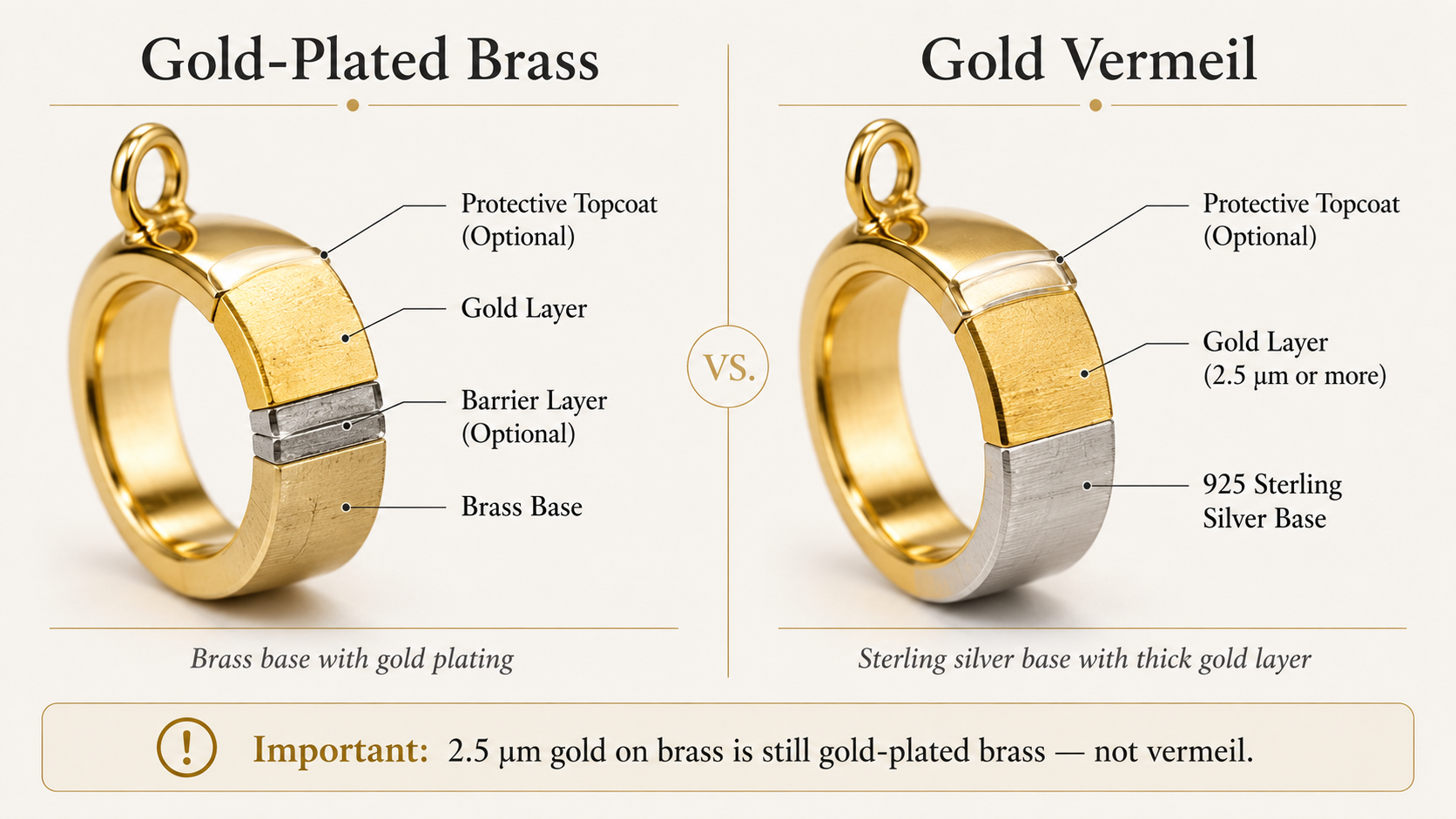
More importantly, the FTC definition of vermeil requires a sterling silver base together with qualifying gold fineness and coating requirements.
That makes the distinction straightforward:
|
Feature |
Thick Gold-Plated Brass |
Gold Vermeil |
|
Base material |
Brass |
Sterling silver |
|
Gold thickness |
Can be customized |
Must satisfy applicable vermeil requirements |
|
2.5 µm or thicker possible |
Yes. |
Yes. |
|
Brass products can be called vermeil. |
No |
— |
|
Typical sourcing role |
Premium fashion / thick-plated collections |
Sterling-silver-based demi-fine collections |
A brass product does not become vermeil simply because its gold coating reaches 2.5 µm or more.
A technically accurate description would instead be
2.5-Micron Gold-Plated Brass Jewelry or Thick Gold-Plated Brass Jewelry
Brands comparing the two structures can also read our guide to 《Gold Vermeil vs. Gold-Plated Jewelry》.
How Should Brands Verify Gold-Plated Brass Quality?
Plating Thickness Should Be Measured, Not Assumed
For bulk jewelry programs, descriptions such as “premium plating” or “thick gold plating” are difficult to enforce unless supported by an agreed technical specification.
X-ray spectrometry is a recognized method for coating-thickness measurement. ASTM B568 specifically covers the measurement of coating thickness by X-ray spectrometry for applicable coating and substrate combinations.
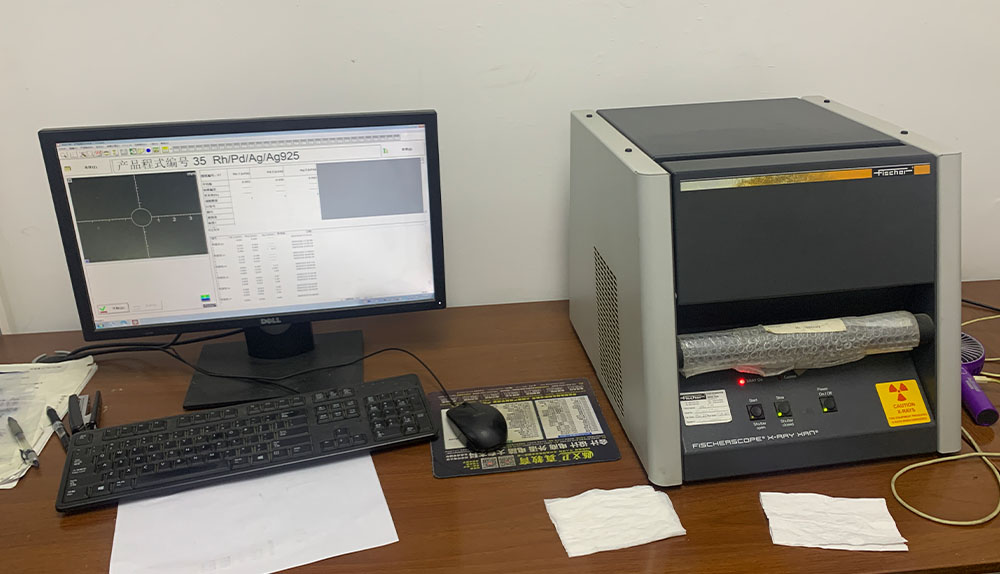
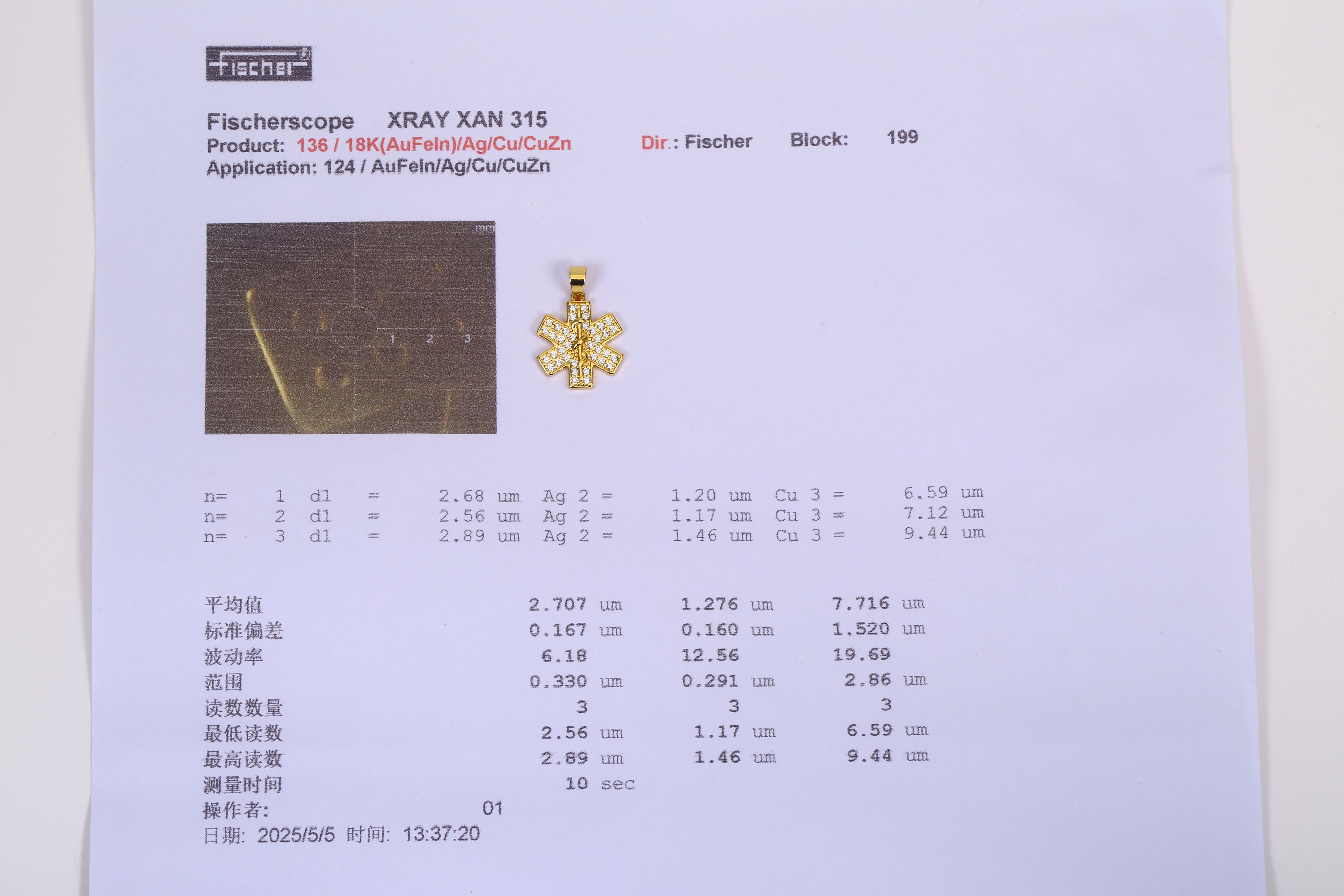
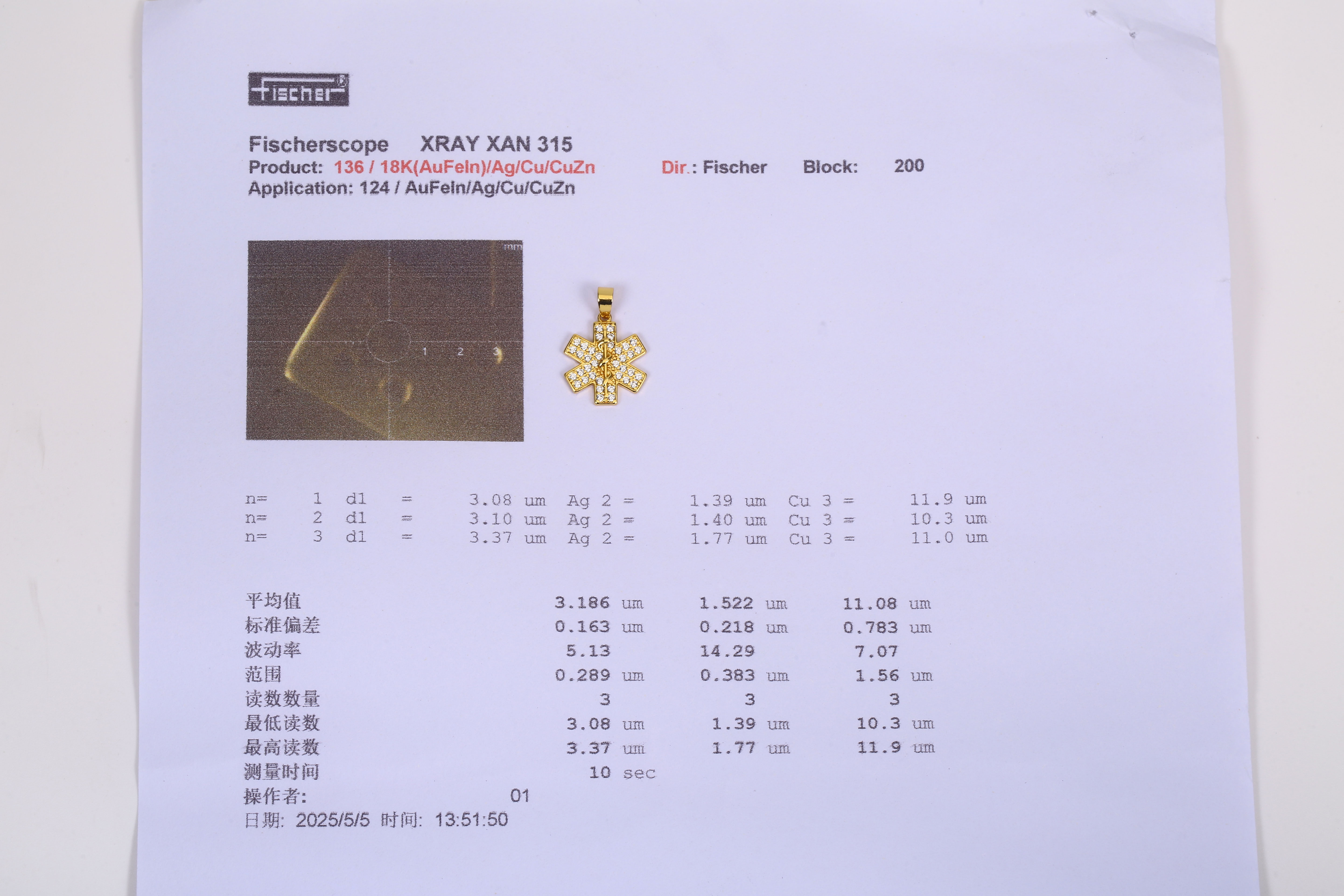
This is why XRF-based verification can be valuable in B2B jewelry sourcing.
A stronger purchase specification defines:
Target Gold Thickness + Measurement Method + Measurement Location + Acceptable Tolerance + Bulk Sampling Requirement
This makes the specification easier to verify when production moves from an approved sample to bulk quantities.
Zhefan's jewelry quality-control process provides further context on how measurable QC can be incorporated into production.
What Salt-Spray Testing Can—and Cannot—Tell a Jewelry Buyer
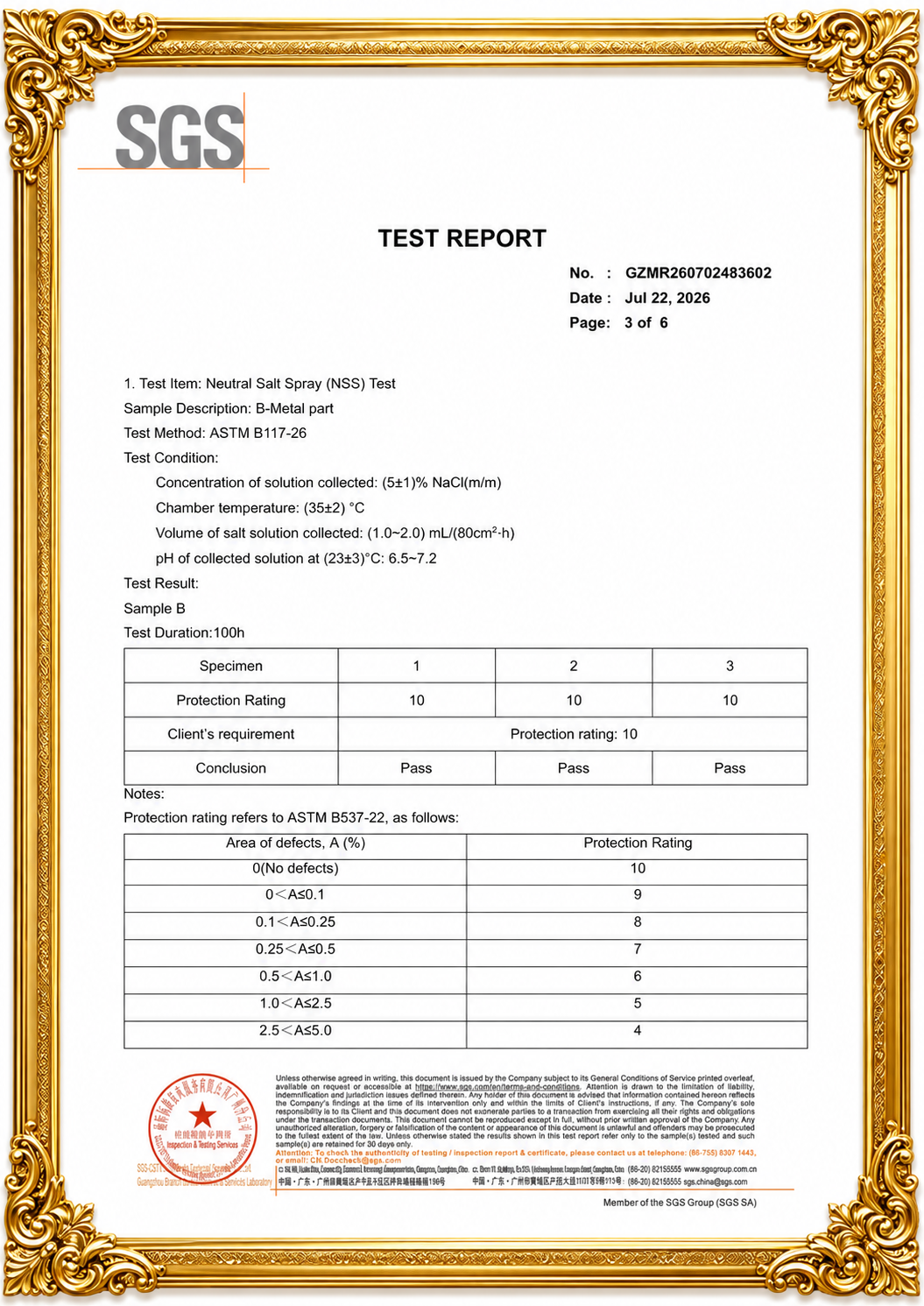
Salt-spray testing can support coating-quality evaluation, but its results are often overstated in jewelry marketing.
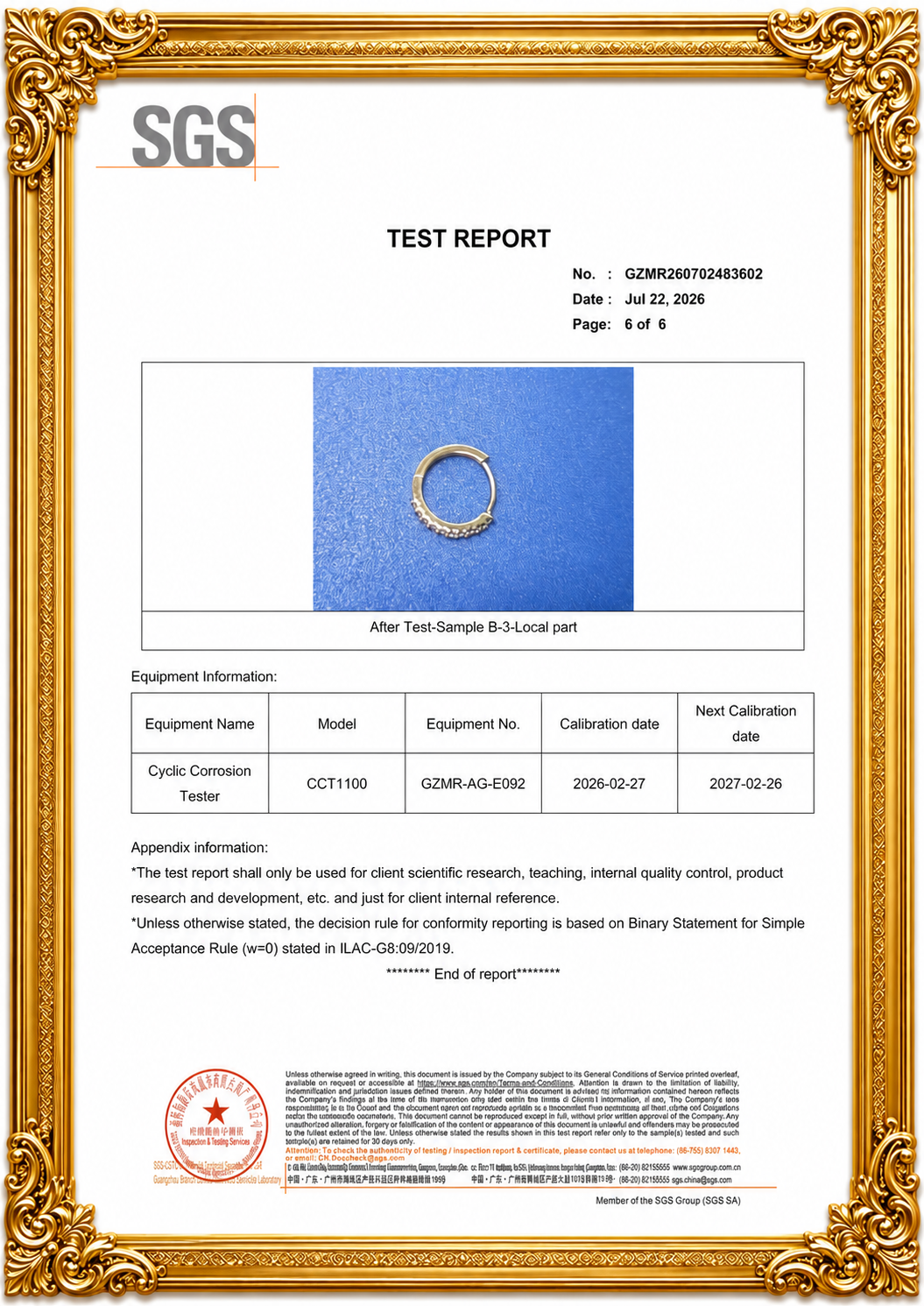
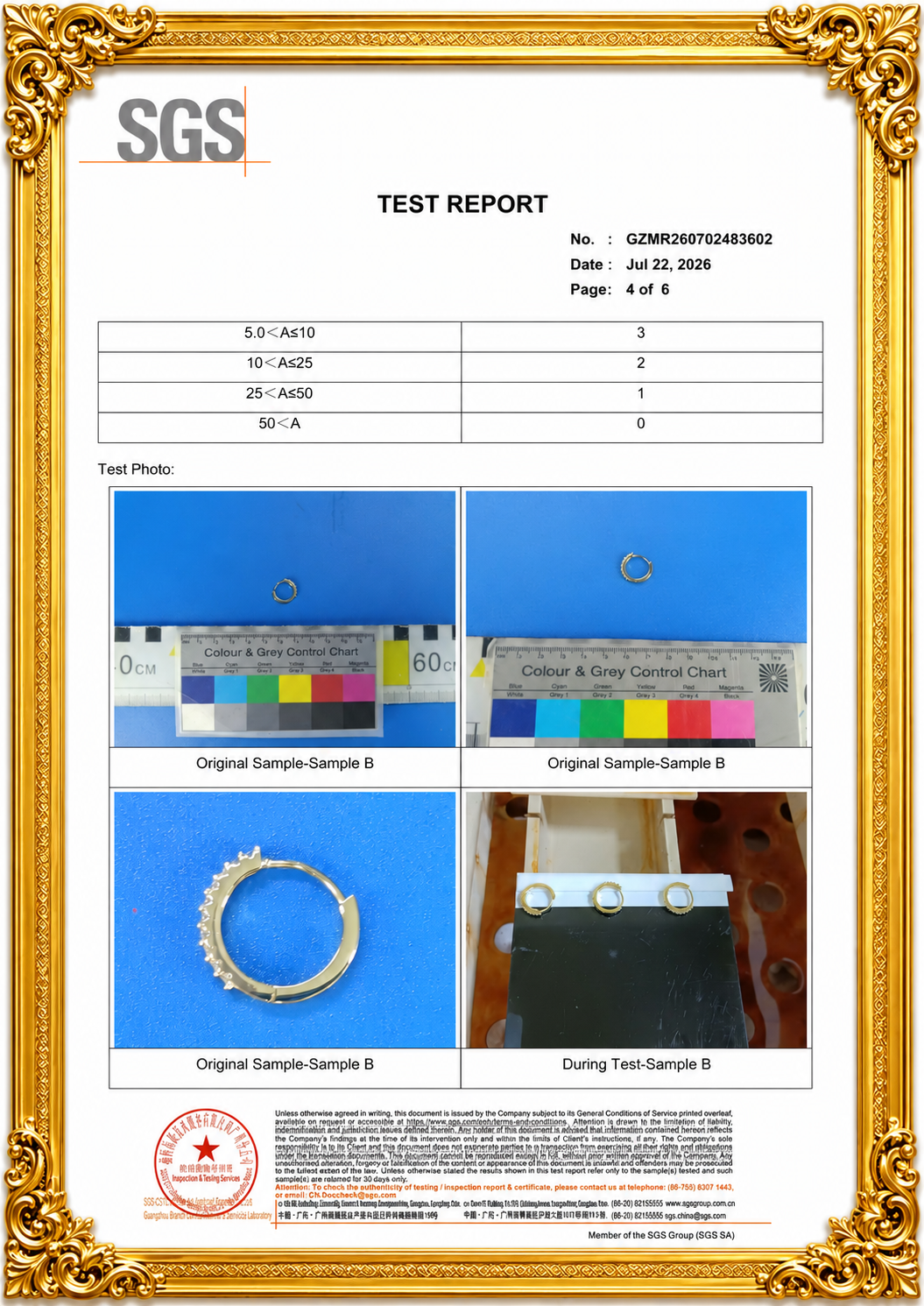
ASTM B117 provides a controlled corrosive environment for obtaining relative corrosion-resistance information on metals and coated metals. Its results should not be treated as a direct prediction of real-world product lifespan.
ISO 9227 also addresses salt-spray corrosion testing under defined conditions and its use in evaluating coating systems.
For jewelry brands, the practical implication is clear:
A salt-spray result is a controlled quality or comparison test—not a direct prediction of how many months or years a customer can wear a piece without visible change.
A stronger QC system combines several forms of evidence.
|
Purpose |
|
|
XRF / X-ray thickness measurement |
Verify coating thickness and, where applicable, composition. |
|
Master-sample comparison |
Control visual consistency from sample to production. |
|
Appearance inspection |
Identify scratches, color variation, pinholes, and surface defects. |
|
Adhesion evaluation |
Identify coating-separation risk. |
|
Salt spray or corrosion testing |
Compare coating behavior under defined accelerated conditions. |
|
Wear-related evaluation |
Assess performance in mechanically exposed areas. |
|
Compliance testing |
Verify requirements relevant to the destination market. |
The objective is not to collect the largest number of reports. It is to build a repeatable QC system with clearly defined acceptance criteria.
For additional detail, see our guide to testing for custom brass jewelry.
What Should Jewelry Brands Confirm Before Bulk Production?
A professional sourcing discussion should result in a specification that both the buyer and manufacturer can verify.
|
Purchasing Question |
Why It Matters |
|
What brass substrate is being used? |
Defines the base material |
|
How is the surface prepared before plating? |
Influences finish quality and adhesion |
|
What gold karat and color are specified? |
Controls appearance and material claims |
|
What is the target plating thickness? |
Creates a measurable coating requirement |
|
What intermediate layer is used? |
Defines the full plating structure |
|
Is a protective topcoat specified? |
Clarifies additional surface protection |
|
How and where will thickness be measured? |
Makes the specification auditable |
|
How will bulk color consistency be controlled? |
Reduces sample-to-bulk variation |
|
Which compliance requirements apply? |
Depends on the destination market |
|
What constitutes an acceptable production lot? |
Establishes objective acceptance criteria |
Once these points are defined, buyers can compare factories on more than price and appearance.
That is the difference between buying gold-colored jewelry and sourcing a controlled gold-plated jewelry specification.
Why the Cheapest Gold-Plated Brass Quote May Not Be the Lowest-Cost Option
Gold thickness influences precious-metal consumption, while surface preparation, intermediate layers, protective finishing, inspection, and testing also affect manufacturing cost.
This is why two suppliers may quote visibly similar pieces at different prices.
For a jewelry brand, the relevant question is whether the quotations represent equivalent technical specifications.
|
Price-First Purchasing |
Specification-Led Purchasing |
|
Compares only unit price |
Compares equivalent technical specifications |
|
Accepts “18K gold plated” as sufficient |
Defines karat, thickness, and coating structure separately |
|
Approves mainly by appearance |
Uses visual approval plus measurable QC |
|
Focuses on initial purchasing cost |
Considers returns, complaints, and repeat-order consistency |
|
Optimizes one order |
Builds a repeatable long-term product standard |
A low quotation can become commercially expensive if inadequate finishing results in premature fading, returns, rework, poor reviews, or inconsistent repeat orders.
The objective is therefore not to specify the thickest possible plating for every SKU but to choose the most appropriate coating system for the product's price point, wear profile, target market, and brand promise.
Gold-Plated Brass or Gold-Plated Sterling Silver?
Gold-plated brass and gold-plated sterling silver serve different brand strategies.
Brass offers strong design flexibility and more flexible base-material economics, making it suitable for fashion-driven collections, larger designs, and brands balancing design complexity with cost.
Sterling silver provides precious-metal value and supports S925 positioning. It is also the required substrate for vermeil when the applicable requirements are satisfied.
|
Decision Factor |
Gold-Plated Brass |
Gold-Plated Sterling Silver |
|
Base-material cost |
More flexible |
Higher |
|
Precious-metal substrate |
No |
Yes. |
|
Large or statement designs |
Cost-efficient option |
Possible at a higher material cost |
|
S925 positioning |
No |
Yes. |
|
Vermeil positioning |
No |
Possible when requirements are met |
|
Typical brand role |
Fashion / premium fashion / private label |
Premium silver / demi-fine / gifting |
|
Main sourcing advantage |
Design-to-cost flexibility |
Precious-metal positioning |
Neither option is universally superior. The correct choice depends on the commercial positioning of the collection.
Sourcing Gold-Plated Brass Jewelry From Zhefan Jewelry
Founded in 1997, Zhefan Jewelry is an OEM/ODM jewelry manufacturer focused on premium brass, 925 sterling silver, and gold vermeil collections for brands, wholesalers, retailers, and private-label businesses.
For gold-plated brass projects, Zhefan can develop plating specifications according to product design, wear profile, target market, quality positioning, and budget rather than applying one standard finish to every SKU.
Available project specifications can include different gold colors and plating thicknesses, XRF thickness verification, nickel-free options, private-label development, and customized packaging.
For the most accurate quotation, brands should provide the design, base material, expected order quantity, target gold color, desired plating specification, destination market, retail positioning, and relevant testing or packaging requirements.
This allows the manufacturing team to recommend an appropriate coating system rather than simply quoting the lowest-cost decorative finish.
Planning a Gold-Plated Brass Collection?
If you are developing a new brass jewelry collection or reviewing the performance of an existing plated product, send Zhefan Jewelry your:
design or reference sample, expected order quantity, target market, gold color, durability requirement, and budget range.
Our team can help evaluate the appropriate base material, plating thickness, layer structure, and QC requirements before sampling.
Request a Custom Plating Specification →
Final Answer: Does Gold-Plated Brass Tarnish?
Yes. Gold-plated brass can tarnish, fade, or change appearance over time.
For jewelry brands, however, tarnish resistance should not be judged from the phrase “18K gold plated” or from micron thickness alone.
Professional sourcing should evaluate the complete system:
substrate preparation → coating structure → gold thickness → product geometry → protective finishing → measurement → testing → production consistency.
This is why two visually similar gold-plated brass products can perform very differently after entering the market.
For B2B sourcing, the strongest approach is to replace subjective descriptions such as “premium plating” or “long-lasting” with measurable specifications, documented inspection methods, and clearly agreed bulk-production acceptance criteria.
FAQ
Does gold-plated brass tarnish?
Yes. Gold-plated brass can eventually fade, wear, or tarnish as the coating system changes through use and environmental exposure. Performance depends on the complete plating structure, product design, surface preparation, and actual wear conditions.
Is gold-plated brass good quality?
It can be. Quality should be evaluated through the brass substrate, polishing and pretreatment, coating structure, gold thickness, process consistency, and QC rather than the phrase “gold-plated brass” alone.
How long does gold-plated brass last?
There is no universal lifespan associated with a particular micron thickness. Real-world performance varies with jewelry type, wear intensity, product geometry, coating structure, and exposure conditions.
Does thicker gold plating last longer?
A thicker deposit provides more coating material before wear reaches the underlying layers. However, poor adhesion, inadequate surface preparation, or coating defects can still cause premature appearance changes.
Is 1-micron gold plating suitable for brass jewelry?
It can be suitable for certain plated jewelry programs, but the specification should be selected according to product type, wear profile, target price, market positioning, and the complete coating system.
Is 2.5-micron gold-plated brass considered gold vermeil?
No. Vermeil requires a sterling silver base together with applicable gold fineness and coating requirements. Brass remains gold-plated brass even when the gold coating reaches 2.5 µm or more.
Is 18K gold plating more durable than 14K gold plating?
Not automatically. Gold karat and coating thickness describe different characteristics. Durability depends on the complete coating specification and intended use.
How can a brand verify gold-plating thickness?
X-ray spectrometry can be used for coating-thickness measurement. ASTM B568 covers coating-thickness measurement by X-ray spectrometry for applicable coating and substrate combinations.
Does a salt-spray test prove that jewelry will not tarnish?
No. Salt-spray testing provides comparative information under controlled accelerated conditions. It should not be interpreted as a direct guarantee of real-world consumer wear life.
What should jewelry brands ask a gold-plated brass manufacturer before ordering?
Brands should confirm the brass substrate, surface preparation, coating structure, gold karat and color, target thickness, verification method, production tolerance, testing requirements, destination-market compliance and sample-to-bulk acceptance criteria.
Recommended for you

Thick Gold Plated Jewelry Manufacturer for 925 Silver & Brass Jewelry

Can Silver or Brass Be PVD Coated? A Professional Guide for Jewelry Brands

PVD Coating vs Electroplating for Jewelry: A B2B Buying Guide for 925 Silver and Brass
14K vs. 18K Gold Vermeil: Which Fits Wholesale?
Product Categories
Discuss Your Ideas with a Professional Custom Jewelry Manufacturer
We provide personalized jewelry customization services for clients worldwide.
Rest assured that your privacy is important to us, and all information provided will be handled with the utmost confidentiality.
By clicking 'Send Inquiry Now' I agree to ZHEFAN JEWELRY processing my personal data.
To see how to withdraw your consent, how to control your personal data and how we process it, please see our Privacy Policy and Terms of use.
From design to production, ZHEFAN JEWELRY offers a one-stop solution to help you enhance your brand value and market competitiveness.
Get A Quote
Contact
Tel: (+86) 188 1927 7817
© 2026 Zhefan Jewelry. All Rights Reserved.
Facebook
Instagram
YouTube
Whatsapp: +8618819277817