






Email: sales3@zhefanjewelry.com
Thick Gold-Plated Brass Jewelry vs Gold Vermeil: A B2B Material Strategy for Jewelry Brands
Compare thick gold-plated brass jewelry vs gold vermeil from a brand sourcing perspective. Understand material cost, plating thickness, durability, design flexibility, retail positioning and OEM quality control before developing your next jewelry collection.
- Thick Gold-Plated Brass and Gold Vermeil May Look Similar, but They Are Different Product Systems
- Thick Gold-Plated Brass vs Gold Vermeil: The Commercial Difference
- Where Thick Gold-Plated Brass Creates a Commercial Advantage
- Where Gold Vermeil Creates the Stronger Product Story
- Why 2.5-Micron Gold-Plated Brass Is Still Not Gold Vermeil
- Plating Thickness Should Follow the Product's Wear Pattern
- Thick Gold Plating Changes the Economics of Brass Jewelry
- Vermeil Cost Is Influenced by Both Silver Weight and Gold Surface Area
- The Same Brand Can Use Both Materials Without Diluting Its Positioning
- Design Geometry Should Influence the Material Decision Before CAD Is Finalized
- What Large Jewelry Brands Should Approve Before Bulk Production
- Why XRF Thickness Verification Matters More as Plating Gets More Expensive
- Durability Should Never Be Reduced to a Guaranteed Number of Years
- How the Material Choice Affects Retail Margin and Inventory Risk
- A Better Way to Choose: Start With the Collection Strategy
- Working With an OEM Manufacturer on Both Material Routes
- Conclusion: Choose the Material System That Protects the Brand Strategy
- FAQ
For jewelry brands developing a new gold-tone collection, choosing between thick gold-plated brass jewelry and gold vermeil is rarely just a question of which material is “better.”
Both can achieve a premium gold appearance. Both can be produced with substantially heavier gold plating than low-cost fashion jewelry. Both can support custom designs, stone setting, branded packaging and repeat production.
Yet they behave very differently once the collection moves beyond the sample table and into commercial scale.
The difference affects not only manufacturing cost, but also product weight, design freedom, inventory investment, retail pricing, material claims, wear expectations and the amount of capital a brand must commit to each SKU.
For established jewelry brands, retailers and private-label programs, the better question is therefore:
Which material system creates the right balance between product architecture, margin, durability and brand positioning for this particular collection?
That is where thick gold-plated brass and gold vermeil begin to serve very different strategic roles.
Thick Gold-Plated Brass and Gold Vermeil May Look Similar, but They Are Different Product Systems
At the surface level, the two products can be remarkably similar.
A polished brass ring plated with 18K gold at a controlled micron thickness can visually resemble an 18K gold vermeil ring made from sterling silver. In photography, retail displays and social-media content, customers may initially perceive almost the same gold tone.
What is underneath that surface, however, changes the commercial structure of the product.
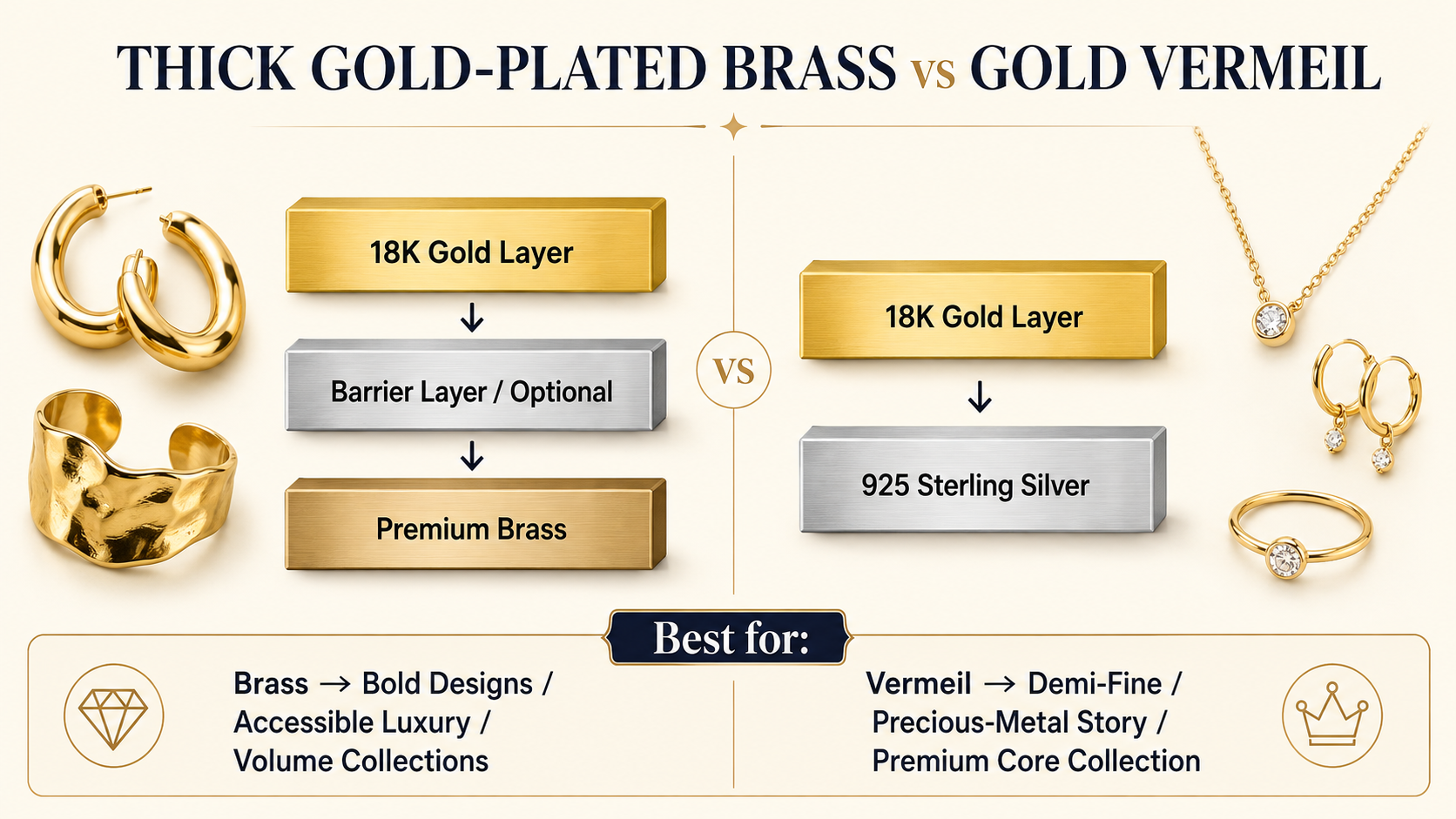
Gold vermeil uses sterling silver as the underlying precious-metal base. Under U.S. FTC guidance, merchandise described as vermeil must use a sterling silver base together with qualifying gold or gold-alloy plating, including the applicable fineness and thickness requirements.
Thick gold-plated brass uses brass as its structural metal and a deliberately specified gold-plating system above it. Even when that plating is 1 micron, 2.5 microns or 3 microns thick, the product remains gold-plated brass, not gold vermeil.
This distinction matters because material terminology is not simply a marketing choice. It influences customer expectations, product-page descriptions, wholesale specifications, cost calculations and the price architecture of the collection.
Thick Gold-Plated Brass vs Gold Vermeil: The Commercial Difference
| Decision Factor | Thick Gold-Plated Brass | Gold Vermeil |
| Base material | Brass | Sterling silver |
| Gold finish | Custom gold electroplating specification | Gold plating over sterling silver meeting the relevant vermeil specification |
| Product positioning | Premium fashion, accessible luxury, statement and bridge collections | Demi-fine, premium and precious-metal-led collections |
| Design flexibility | Particularly strong for bold, large and structural designs | Strong for refined, lightweight and precious-metal-focused designs |
| Material cost exposure | Lower than sterling silver | More sensitive to silver weight and silver market value |
| Gold cost exposure | Depends heavily on surface area and micron thickness | Depends on surface area, thickness and applicable vermeil specification |
| Weight economics | Better suited to larger-volume metal designs | Large solid designs can become costly because of silver weight |
| Retail material story | Design, craftsmanship and upgraded plating | Sterling silver plus qualifying gold-plating story |
| Naming | Thick gold-plated brass / heavy gold-plated brass | Gold vermeil where applicable requirements are met |
| Inventory strategy | Easier to expand into more SKUs at controlled investment | Often better suited to curated higher-value SKUs |
| Typical commercial role | High-volume hero products, statement pieces, diffusion ranges | Signature collections, premium core lines, demi-fine programs |
The critical point is that a brand should not compare these materials only by the price of one finished sample.
The comparison needs to be made at collection level.
Where Thick Gold-Plated Brass Creates a Commercial Advantage
Thick gold-plated brass becomes particularly attractive when the design itself consumes a large amount of metal.
Consider a chunky hoop earring, sculptural cuff, oversized pendant, wide bangle or statement necklace. If the same physical silhouette is manufactured entirely in sterling silver, metal weight can rapidly increase the production cost.
The issue becomes even more significant across a collection containing multiple sizes and dozens of SKUs.
Brass gives designers more room to retain visual volume without allowing the base-metal cost to dominate the product.
This does not mean the collection has to feel inexpensive.
With precise casting, controlled polishing, properly engineered intermediate layers, real-gold plating and a suitable final protective treatment, brass can support a sophisticated surface finish for premium fashion and accessible-luxury programs.
For brands whose value proposition is driven strongly by design, silhouette, color, stone setting and styling, this flexibility can be commercially important.
Instead of simplifying an oversized design purely to reduce silver weight, the brand can preserve the intended scale while investing more selectively in plating quality, stones, finishing and packaging.
That creates a different kind of premium product.
Where Gold Vermeil Creates the Stronger Product Story
Gold vermeil becomes more compelling when the underlying material is part of the customer's reason for buying.
For many demi-fine brands, sterling silver is not hidden technical information. It is central to the product proposition.
The customer may specifically expect a precious-metal base underneath the gold finish. The brand may also want to build a clear hierarchy between lower-priced fashion jewelry and solid-gold fine jewelry.
Gold vermeil can occupy this middle position effectively.
It allows brands to communicate a sterling-silver foundation while maintaining a gold appearance at a lower investment than solid-gold production.
This can be particularly suitable for refined earrings, stacking rings, pendant necklaces, charm jewelry, tennis-inspired styles and signature pieces intended to remain in the assortment for multiple seasons.
In these cases, the higher base-metal cost can support the commercial story rather than simply adding manufacturing expense.
Why 2.5-Micron Gold-Plated Brass Is Still Not Gold Vermeil
One of the most important sourcing distinctions is that plating thickness alone does not determine whether jewelry is vermeil.
A brand may specify 2.5-micron or even 3-micron gold plating on brass. That can produce a significantly upgraded gold-plated brass product with better wear potential than very thin fashion plating.
It still should not be described as gold vermeil.
Vermeil is defined by the combination of the underlying sterling silver and qualifying gold coating rather than by thickness alone.
This matters commercially because vague terminology can create problems later in product listings, retailer onboarding, customer-service communication and material verification.
Large brands therefore benefit from keeping the SKU specification precise.
A brass SKU should state its brass base and agreed gold-plating specification. A vermeil SKU should state its sterling silver base together with the applicable gold specification.
Clear terminology protects both the buyer and the supplier.
Plating Thickness Should Follow the Product's Wear Pattern
The next mistake brands often make is applying one plating specification across an entire collection.
A pendant and a ring do not experience the same mechanical environment.
A pendant may spend most of its life suspended from a chain with relatively limited surface friction. A ring is repeatedly exposed to hands, desks, bags, soaps, cosmetics and continuous contact with surrounding objects.
Bracelet links rub against one another. Bangles contact desks and clothing. Clasp areas experience repeated metal-to-metal movement. Raised edges and corners can receive more abrasion than protected recessed surfaces.
For this reason, plating specification should be related to the wear profile of the design, not only its retail category.
A thicker layer may improve the available wear margin, but thickness alone cannot compensate for poor polishing, weak adhesion, unsuitable intermediate layers or badly prepared surfaces.
Professional sourcing therefore treats plating as a system.
The brand needs to consider the brass or silver substrate, polishing standard, surface cleanliness, intermediate layer where required, gold layer, product geometry, protective coating and final inspection together.
Thick Gold Plating Changes the Economics of Brass Jewelry
Brands sometimes assume that using brass automatically creates a low-cost product.
That is not necessarily true once premium plating specifications are introduced.
Gold consumption increases with both surface area and plating thickness.
A thin, minimalist brass ring and a wide sculptural brass cuff may therefore have completely different plating economics even if they use the same micron specification.
For large-volume OEM orders, this is especially important.
Increasing plating thickness across a 10,000-piece order can materially affect the total gold consumption of the project. If the design is large or highly three-dimensional, surface area becomes another major variable.
This is why professional quotations should not reduce the specification to phrases such as “18K gold plated” or “heavy gold plated.”
The quotation should identify the base material, construction, approximate weight, gold color, agreed plating specification, stone requirements and finishing standard.
Otherwise, two apparently similar supplier quotations may represent materially different products.
Vermeil Cost Is Influenced by Both Silver Weight and Gold Surface Area
Gold vermeil introduces an additional cost variable: the value of the sterling silver structure itself.
For lightweight earrings and refined pendants, this may fit the desired price architecture very well.
For oversized cuffs, heavy chain designs or large sculptural earrings, silver weight can become commercially significant.
A jewelry brand should therefore evaluate whether the customer actually values the additional precious-metal content enough to support the resulting retail price.
If the design is primarily purchased because it is visually dramatic, brass may sometimes create a stronger margin structure.
If customers deliberately seek precious-metal construction, vermeil may justify the additional material investment.
The decision should therefore be driven by customer value perception rather than material hierarchy alone.
The Same Brand Can Use Both Materials Without Diluting Its Positioning
For larger jewelry brands, thick gold-plated brass and gold vermeil do not necessarily need to compete.
They can serve different jobs inside the same assortment.
A brand might develop architectural hoops, bold cuffs and seasonal statement necklaces in premium thick gold-plated brass while reserving gold vermeil for refined charms, stacking rings, signature pendants and long-term core SKUs.
This allows the brand to create multiple price points without forcing every design into the same material system.
The important requirement is clarity.
The different collections should have transparent material descriptions, suitable pricing, appropriate care information and internally separate product specifications.
The goal should not be to make gold-plated brass appear to be vermeil.
The goal should be to make each material feel intentional within its own product tier.
That distinction is particularly important for established brands, where customer trust depends on consistent product language across websites, packaging, retailers and customer-service teams.
Design Geometry Should Influence the Material Decision Before CAD Is Finalized
Material selection is most effective when it happens during product development rather than after the design is complete.
Changing from brass to sterling silver after the sample stage can affect much more than cost.
Metal density, wall thickness, casting structure, soldering points, stone settings, clasp design and overall hand feel may need to be reconsidered.
A large hollow brass earring, for example, cannot always be translated directly into sterling silver using exactly the same internal construction.
Likewise, a delicate vermeil design may require structural changes if converted into a heavier brass statement version.
For brands planning parallel brass and vermeil versions, both should therefore be engineering decisions rather than simple material substitutions.
CAD, target weight, dimensions, wall thickness, stone settings and connection points should be reviewed for each material route.
What Large Jewelry Brands Should Approve Before Bulk Production
A premium sample is not enough to protect a large production order.
The approved sample must be supported by a written specification.
For thick gold-plated brass, that specification should clearly identify the brass substrate, gold color, plating requirement, visible finish, stone setting, components and any protective coating.
For gold vermeil, the specification should additionally define the sterling silver basis and qualifying gold application appropriate to the target market.
Color references are particularly important.
Terms such as “18K gold,” “European gold,” “light gold” or “champagne gold” are not sufficiently precise on their own to guarantee that different production batches will look identical.
The first approved production sample should therefore become a physical color and finish benchmark wherever practical.
Large brands should also remember that plating consistency has to be controlled across surfaces that are not equally easy to plate.
Corners, recessed details, stone-setting areas, hinge sections, prongs, chains and clasp components can behave differently during processing.
A professional factory should therefore inspect not only the most visible flat surface but also the high-risk details where inconsistency or early wear is more likely to appear.
Why XRF Thickness Verification Matters More as Plating Gets More Expensive
When a brand orders upgraded plating, the value of objective verification increases.
A visual inspection can identify color differences, roughness, scratches and many surface defects, but it cannot reliably confirm whether a requested micron specification has actually been achieved.
XRF coating-thickness measurement provides a non-destructive way to verify plating thickness on selected areas of finished jewelry.
For B2B programs, this creates a more useful quality-control language between manufacturer and buyer.
Instead of relying entirely on phrases such as “premium plating” or “long-lasting gold,” the brand can specify a measurable target and request corresponding inspection documentation where appropriate.
This becomes increasingly important when the difference between two quotations is largely created by gold thickness.
Durability Should Never Be Reduced to a Guaranteed Number of Years
Both thick gold-plated brass and gold vermeil are surface-finished products.
Neither should be treated like solid gold.
Actual wear depends on product design, friction, sweat, cosmetics, water exposure, storage, cleaning habits, plating integrity and individual use conditions.
For this reason, responsible brands should be cautious about universal promises such as “will never fade,” “permanently waterproof” or “guaranteed to last five years” unless a very specific claim is supported by appropriate testing and conditions.
The better approach is to engineer the finish for the intended product environment and communicate care expectations accurately.
This is especially important for premium brands because aggressive durability claims may increase short-term conversion while creating greater customer-service risk later.
How the Material Choice Affects Retail Margin and Inventory Risk
The strongest material is not always the material that creates the strongest business.
Brands should consider the full economics of each SKU.
A vermeil piece may have a higher unit production cost but also support a higher retail price and stronger customer perception.
A thick gold-plated brass product may produce a lower base-metal cost, but a large surface area and premium gold thickness can still make plating a significant cost component.
Inventory strategy matters as well.
If a collection is trend-sensitive and requires many styles, colors or seasonal variations, brass can sometimes allow the brand to allocate capital across more SKUs.
If the collection is built around a smaller group of signature designs with longer selling cycles, investing more deeply in vermeil inventory may make greater commercial sense.
Large jewelry companies therefore benefit from evaluating gross margin, stock turn, repeat-order potential and customer lifetime value together, rather than treating material cost as the only sourcing KPI.
A Better Way to Choose: Start With the Collection Strategy
The most effective sourcing process begins with the intended customer and retail architecture.
If the product needs a strong sterling-silver story, a demi-fine position and a long-term premium role, gold vermeil is usually the more coherent starting point.
If the design is bold, metal-intensive, trend-driven or intended for wider-volume distribution, thick gold-plated brass may provide better design and cost flexibility.
If a brand needs both premium and accessible price levels, the strongest solution may be a controlled combination of the two.
The material should support the collection.
The collection should not be forced to support a material simply because one term sounds more premium.
Working With an OEM Manufacturer on Both Material Routes
For jewelry brands developing both brass and gold vermeil collections, working with a manufacturer capable of controlling both systems can simplify color matching, CAD development, stone standards, finishing and repeat production.
Brands can develop customized material specifications, gold colors, plating thicknesses, stone selections, product structures, logo details and packaging according to the positioning of each collection.
For plating-sensitive projects, thickness inspection and XRF reporting can also be incorporated into the quality-control process according to the project requirements.
The objective is not simply to offer a thicker coating.
It is to match the base metal, design geometry, plating specification and QC process to the product's intended market position.
For brands comparing brass and vermeil versions of the same concept, Zhefan Jewelry can also evaluate the design before sampling to determine whether weight, structure or plating specifications should be adjusted for each material.
Conclusion: Choose the Material System That Protects the Brand Strategy
Thick gold-plated brass and gold vermeil should not be viewed as a simple good-versus-better hierarchy.
They are two different product-development tools.
Gold vermeil offers a sterling-silver foundation and a stronger precious-metal story for brands building demi-fine and premium collections.
Thick gold-plated brass offers greater freedom for scale, structure, statement design, volume and controlled product cost while still allowing brands to specify substantially upgraded plating quality.
For established jewelry brands, the strongest sourcing decision is the one that connects material choice with design, wear conditions, target retail price, inventory strategy and measurable manufacturing specifications.
Once those factors are aligned, the difference between brass and vermeil becomes more than a materials question.
It becomes part of the brand's product architecture.
FAQ
Is thick gold-plated brass better than gold vermeil?
Neither is universally better. Thick gold-plated brass can be more commercially suitable for large, structural, high-volume or design-led jewelry, while gold vermeil is usually stronger for demi-fine collections where a sterling silver base is part of the customer value proposition. The best choice depends on the design, price architecture, and intended market positioning.
Is 2.5-micron gold-plated brass considered gold vermeil?
No. A thick gold coating does not turn brass into vermeil. Gold vermeil requires a qualifying sterling silver base together with the applicable gold-plating specification. A brass product with a 2.5-micron gold coating should still be described as thick gold-plated brass or with another accurate brass-based material description.
Can thick gold-plated brass be used for premium jewelry brands?
Yes. Premium positioning does not depend only on whether the underlying metal is silver or brass. Design originality, weight, polishing, plating specification, stone quality, setting quality, packaging, and manufacturing consistency all influence the finished product. Brass is particularly useful for bold or metal-intensive designs where sterling silver would create unnecessary cost.
Which lasts longer, thick gold-plated brass or gold vermeil?
There is no universal lifespan comparison because wear depends on the actual plating specification, surface preparation, design geometry, friction, protective finishing and customer use. A poorly manufactured vermeil product can perform worse than a well-engineered thick gold-plated brass product. The full coating system should therefore be evaluated rather than the material name alone.
What gold plating thickness should a jewelry brand choose for brass?
The appropriate thickness depends on the product's retail tier, surface area, wear pattern, and budget. Necklaces typically experience different abrasion from rings and bracelets, so applying one thickness requirement across an entire collection is not always appropriate. Premium projects should establish the required micron specification during sampling and verify that specification where appropriate.
Can the same jewelry design be made in brass and gold vermeil?
Often yes, but it should not automatically be treated as a direct material substitution. Changes in metal weight, wall thickness, casting behavior, structural strength, soldering points, and stone settings may require CAD or construction adjustments. Each material version should ideally receive its own engineering review and sample approval.
Should brands ask for an XRF plating thickness report?
For projects where plating thickness is an important part of quality, cost, or product positioning, XRF verification can provide useful objective evidence. It is particularly valuable for premium thick-plated brass and vermeil programs where different micron specifications can create meaningful differences in production cost.
Is thick gold-plated brass suitable for large-volume OEM jewelry production?
Yes. Brass is particularly useful for larger-volume collections because it supports complex casting, stone setting, polishing, and substantial design scale while providing more control over base-metal cost than sterling silver. For successful repeat production, however, the brand should define the exact plating specification, finish, color standard, and quality-control requirements rather than purchasing under a vague “gold plated” description.
Recommended for you

What Is Gold Vermeil Jewelry? A Complete Guide for Brands and Retailers

Thick Gold Plated Jewelry Manufacturer for 925 Silver & Brass Jewelry

How to Choose a Gold Vermeil Jewelry Manufacturer

Gold Vermeil vs. Gold-Plated Jewelry: Which Fits Your Luxury Jewelry Brand?

Can Silver or Brass Be PVD Coated? A Professional Guide for Jewelry Brands
How to Make Bulk Jewelry Match the Approved Sample: A Production Control System for Jewelry Brands
Product Categories
Discuss Your Ideas with a Professional Custom Jewelry Manufacturer
We provide personalized jewelry customization services for clients worldwide.
Rest assured that your privacy is important to us, and all information provided will be handled with the utmost confidentiality.
By clicking 'Send Inquiry Now' I agree to ZHEFAN JEWELRY processing my personal data.
To see how to withdraw your consent, how to control your personal data and how we process it, please see our Privacy Policy and Terms of use.
From design to production, ZHEFAN JEWELRY offers a one-stop solution to help you enhance your brand value and market competitiveness.
Get A Quote
Contact
Tel: (+86) 188 1927 7817
© 2026 Zhefan Jewelry. All Rights Reserved.
Facebook
Instagram
YouTube
Whatsapp: +8618819277817